

I.
One Battle After Another is a cool ass movie.
I could reasonably end my critique there, because to me, if I had a good time, then it’s a good movie. I saw Paul Thomas Anderson’s new movie less than a week after I lost my apartment and belongings in a fire. And it made me feel alive. In an essay titled “Trash, Art, and the Movies” for Harper’s in 1969, film critic Pauline Kael wrote, “A good movie can take you out of your dull funk and the hopelessness that so often goes with slipping into a theatre; a good movie can make you feel alive again, in contact, not just lost in another city. Good movies make you care, make you believe in possibilities again. If somewhere in the Hollywood-entertainment world someone has managed to break through with something that speaks to you, then it isn’t all corruption. The movie doesn’t have to be great; it can be stupid and empty, and you can still have the joy of a good performance, or the joy in just a good line.”
Leonardo DiCaprio, playing stoner ex-revolutionary Ghetto Pat, does some of his best work in years. Not just dramatic work, but comedic work. The days of his relentless hunt for an Oscar are over. This is not The Revanant or Revolutionary Road. This is the DiCaprio who first made me fall in love with him during Gangs of New York. A polarizing Scorsese film, but I watched it on Christmas Day, my junior year of high school. It was the best Christmas gift I received that year, watching DiCaprio go mano a mano with a staggering, scenery-guzzling Daniel Day-Lewis. I fucking love movies.
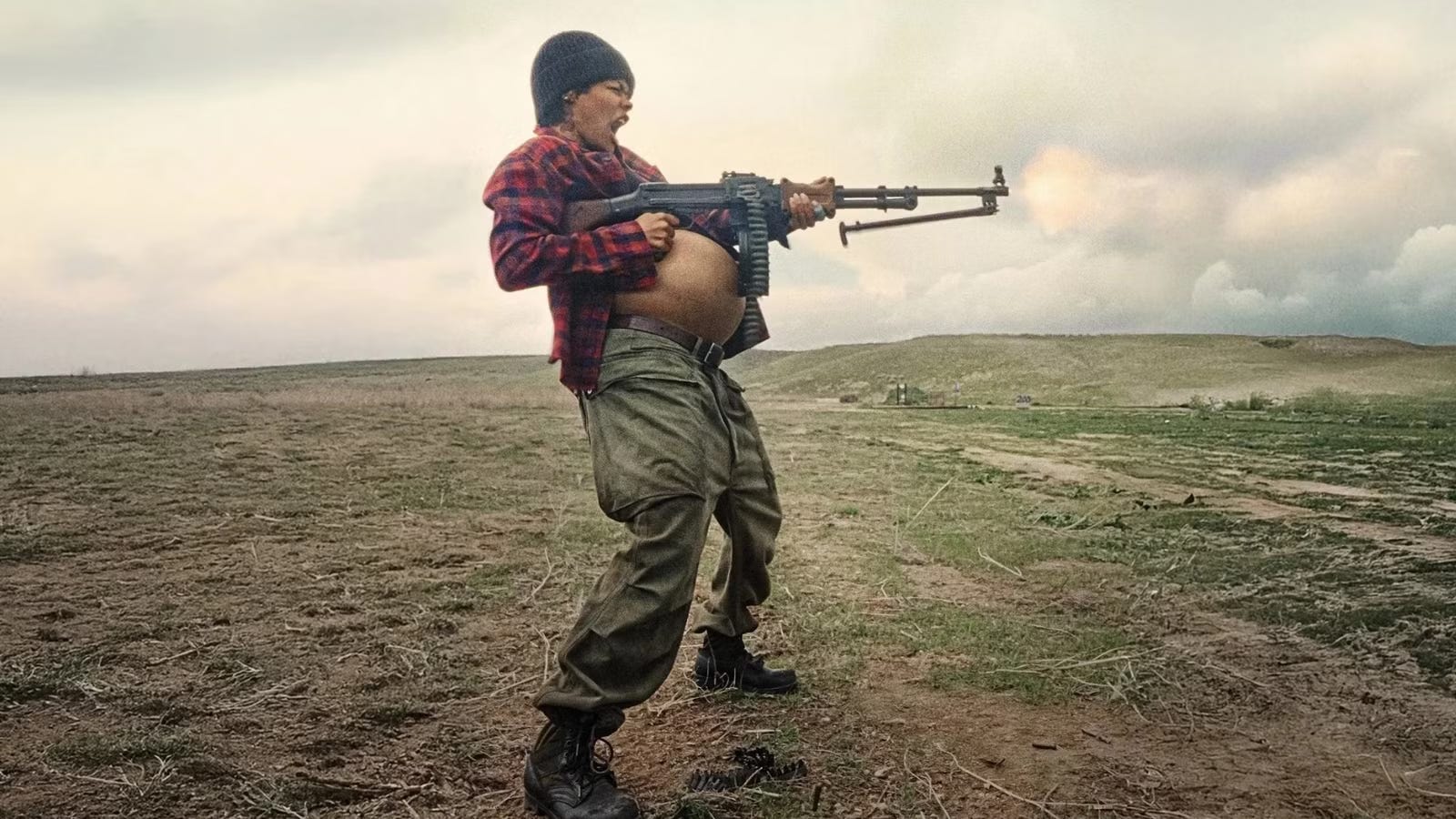
Teyana Taylor is electric. The first third of the film is centered around her character Perfidia Beverly Hills and her partner Ghetto Pat as they blow up shit, free detained immigrants, and rob banks with the revolutionary group the French 75. She holds an automatic rifle with ease, mandhandling it the same way she does Sean Penn’s dick in the movie’s opening scene. After garnering critical acclaim in One Thousand and One, she’ll likely catch even more and rack up some award nominations for this performance. The role hasn’t been without criticism, which, duh, she’s a black woman in a PTA film. Does he know how to write black women? Perfidia lacks some necessary depth, but also one of the best roles in PTA’s Magnolia is black journalist Gwenovier (April Grace). There’s also the cool as fuck cadre of gun-toting black nun revolutionaries in One Battle. This movie even has some nunsploitation! I’d love to see an entire film about them. PTA probably shouldn’t direct it.
In the opening scenes of One Battle, the camera leers at Taylor’s ass in tight jeans. But this is Penn’s character, Colonel Steven J. Lockjaw’s POV, and he’s a sleaze who stomps around in scenes like he’s Vince McMahon. Taylor and Penn have a kinky sex scene where she shoves a gun up his ass. Is it the sexual exploitation of a black woman or just the sexual exploitation of a woman? PTA is a horny motherfucker. If you haven’t seen him eat pizza and talk about how watching porn all day inspired Boogie Nights. He likes sex, and he likes to fuck. If no one wanted to fuck Taylor in One Battle, it would not be a PTA film. One of the HAIM sisters is in the film. She’s not sexualized, sure. But I don’t think PTA wants to fuck one of the HAIM sisters. Heather Graham turns him on. Julianne Moore turns him on. All a HAIM sister can do for PTA is play the drums.
It’s been argued that the film exploits black women and Taylor’s character in general. This should not come as a surprise. PTA makes exploitation films! Boogie Nights is a whitesploitation film. One Battle is his first foray into blaxploitation, before it abandons Taylor’s character to return to whitesploitation, which is what PTA does best. The film uses the backdrop of ‘70s revolutionaries, white supremacy, and westerns to tell a story about DiCaprio attempting to save his daughter’s life from Penn’s evil military man, Lockjaw. It’s not an accurate representation of “the revolution,” but Gil Scott-Heron said the revolution wouldn’t be televised anyway. bell hooks lobbied the same critique at Spike Lee’s Malcolm X in Art Forum: “As Michele Wallace warns, there is no place in Hollywood movies for the ‘seriousness of black liberation.’ Lee’s film is no exception. It does not compel us to confront, challenge, and change. It encourages us to weep but not to fight.” One Battle After Another is not a documentary. It’s not a call to arms. I never expected it to be; it’s a melodrama. As one of the great melodrama directors, Douglas Sirk, said, “I’ve always been trusting my audience to have imagination, otherwise they should stay out of the cinema. The moment you start preaching in a film, the moment you want to teach your audience, you’re making a bad film.”
II.
When Fiona Apple released Fetch the Boltcutters, she spoke to The New Yorker about her tumultuous three-year relationship with Paul Thomas Anderson. He threw a chair across a room after losing Best Original Screenplay in 1998 for Boogie Nights. During one fight in 2000, he shoved her out of a car. She says he never hit her, but at parties they blew through cocaine and ecstasy, and he’d quietly hiss to her that she was a bad partner.
PTA declined to comment for the interview, but he’s been commenting on his relationship with Apple for most of his career. Punch Drunk Love, a film I saw for the first time recently and did not love, sees PTA confront male rage and loneliness. Adam Sandler plays Barry Egan, a salesman who calls phone sex lines and breaks shit when he’s frustrated. Throughout the film, he’s punished by Philip Seymour Hoffman’s Dean Trumbell for his sexual predilections. In the end, Sandler is saved by the love of a woman. Phantom Thread sees Day-Lewis as Reynolds Woodcock, a domineering dressmaker. He’s punished by his lover Alma (Vicky Krieps) for his behavior when she slowly poisons him with mushrooms so she can nurse him back to health. When she seeks to poison him again, Woodcock willingly acquiesces.
One Battle sees Pat chastised by Perfidia’s mother for ruining her daughter’s life and causing her to stray from her lineage of real revolutionaries. His daughter, Willa (Chase Infiniti), hates him for being a shitty father. Pat is largely useless to everyone in this film. Willa saves herself in the end.
PTA was raised Catholic, but has said that he now finds religion “dull, which is too bad because it’s not dull. The stories they were telling were good stories… the music was kinda boring.” Who needs church when you can repent for your sins in your movies and include a bitching soundtrack with songs from Steely Dan, The Jackson 5, and Travis Scott?
III.
I love how highly Quentin Tarantino thinks of himself. He is an Aries, after all. When asked about David Fincher directing The Adventures of Cliff Booth, the sequel to Tarantino’s Once Upon a Time… in Hollywood, he said, “I think me and David Fincher are the two best directors. So the idea that David Fincher actually wants to adapt my work, to me, shows a level of seriousness towards my work that I think needs to be taken into account.”
Tarantino is one of my favorite filmmakers, but let’s be honest here, his best friend has him beat in the filmmaking department. Tarantino films are cool; they’re bold and engrossing. I cannot wait to see Kill Bill: The Whole Bloody Affair this December, finally. But often, Tarantino’s films are about their influences and just doing cool shit (except for Kill Bill, that one has a real emotional core). In the aforementioned New Yorker interview, Fiona Apple described the night that made her quit cocaine: “Every addict should just get locked in a private movie theatre with Q.T. and P.T.A. on coke, and they’ll never want to do it again.” Tarantino and PTA are both movie nerds who’ve done a bunch of blow and watched a shit ton of movies and incorporated all the cool shit they’ve seen in those movies into their movies.
Tarantino’s influences are westerns, Hong Kong action flicks, and ‘70s horror. PTA’s influences are the same shit, and ‘90s porn (apparently), but he also has an affinity for romance and melodrama that Tarantino does not possess. Tarantino does not have the patience to make a movie like Phantom Thread. PTA, on the other hand, made a sumptuous psychological thriller inspired by movies like The Passionate Friends, Brief Encounter, The Earrings of Madame de…, Vertigo, and Rebecca. That’s some real faggot shit right there, okay? You expect gay film nerds to love Jonathan Demme films. But not a film bro. PTA believes in love. He’s a romantic.
PTA has been in a relationship with Maya Rudolph since 2001. Her mother, Minnie Riperton, wrote the song “Lovin’ You” in 1974 for Rudolph about her husband, but also as a way to distract Rudolph as a baby. It’s a song about making love and growing old together, and it’s also a wistful lullaby. DiCaprio’s relationship with his biracial daughter in One Battle After Another is likely inspired by PTA’s relationship with his own biracial children. It’s a love letter. And love is messy. You don’t always get it right. But you can see his soul in it.
really loving this triplicate format, ira, and so happy to be reading your words again after the fire. <3
This is the exact review I needed 🙏 You covered everything running through my head during OBAA! Do you think I’m reading too much into it if I see Leo & Sean as two sides of Anderson’s parenting?