

I’ve never been accused of performative reading. Okay, there was the time my friend joked about me bringing The Brothers Karamazov to a club, but it was in my tote bag, and I’d been reading it in the park. And yes, I do leave the dust jackets on hardcovers when I read in public, but that’s because I love checking out what other people are reading (especially on the subway), and it’s easier when you can see the cover. While reading Life of M on the subway recently, I saw several other people reading either the same or a different Rachel Cusk novel. (Is it Cusktember?) But I’ve never found the argument of “performative reading” to be serious. Maybe the dudes who read Infinite Jest or Gravity’s Rainbow in public are being performative. But we live in an era where people are severely lacking in independent thought and love being told what to do. It’s why the most popular newsletters on Substack are often just link round-ups. People don’t merely want to know what’s cool; they want to be told what to do. And if a man sees another man reading a book in public with a cool cover, chances are, they’ll buy the book as well. That’s not being performative; that’s marketing.
The need to be part of a cultural conversation will always trump the fear of being performative. It’s why some people feel that they have to finish a book if they’ve started it. Or, they’ll take to social media midway through a book and ask people to convince them to finish it. Is it worth it? Does it get better? How about you just… don’t keep reading it? Enter DNF.
DNF is shorthand for “did not finish” and has primarily been a BookTok term until Goodreads added a shelf to its app where users could add books they didn’t finish. Already an option on other book tracking apps, in theory this should make people less ashamed to abandon a book. I’m often asked how I read so many books (thirteen this past month; the list will be at the end of this post). On a recent episode of Feedback, I responded to Vulture’s “How 20 Well-Read People Make Time for Books,” with my own methods.
Generally, I wake up around sunrise each morning to read with my morning coffee before I write. I also live in Brooklyn, where my commute to and from Manhattan is on average an hour each direction. That’s where the bulk of my reading gets done. I’ve also recently begun alternating reading a chapter and listening to the audiobook if I’m a fan of the narrator or the book is dialogue-heavy (Cusk novels, for instance). Another thing I do? I abandon books I’m not reading very quickly.
My friend John Paul Brammer’s recent advice for reading more addresses how you should feed your curiosity at all times when reading: “It’s difficult to pursue anything you don’t have a genuine appetite for. Absent appetite, some other incentive (a salary, necessity) has to compensate. The benefits of literature are abstract enough that reading is almost exclusively a leisure activity. “Make reading fun” sounds too simple, because it is an oversimplification. Some of the most worthwhile books are not, strictly speaking, fun, and those are exactly the books we have in mind when we imagine a more serious reading life. But fun is a wonderful starting point because fun and play lend themselves to curiosity. Curiosity is an attention multiplier.”
Finishing a book for book club might be an incentive, but that’s the reason my previous book clubs often failed: people struggled to finish books they wanted to quit. (I now prefer impromptu book clubs, where I find out which friends have read the same novel as me, and we get together to talk about it.) A book is a lot harder than sitting down to watch a film or television show. It takes effort. But this is perhaps why many people have turned DNF into a performance.
In the absence of performative reading, many people on social media are now performatively not reading. Traditionally, the way I’ve kept track of the books I didn’t finish is by sticking them back on my shelf or leaving them in a pile with other books I’ve abandoned. The idea isn’t that they’ve been abandoned forever, but that they don’t currently hold my interest and I’d rather move on to something I’ll actually enjoy reading. But it is the very fact that reading does take effort that people still want credit for a book they haven’t actually read.
Yesteryear is the biggest book of the year. At over 1.4 million copies sold, Caro Claire Burke’s novel isn’t just being bought by habitual readers; it’s being bought by casual readers or people who haven’t picked up a book in years. It’s the book to talk about this summer. People love to hate the protagonist, but they love to hate Burke as well. I know plenty of writers who’ve also grabbed the book to see what the fuss is about or just so that they can feel justified dragging it after they’ve read it. I love it. I love reading a book so I can join in on dinner party conversations or argue online about it. But if I haven’t read the book, I’d shut up about it.
Similarly, if you haven’t seen The Drama or Obsession, why would you join a debate about the films? It’s more common than you think. Increasingly, I’ve argued about a film with someone only to discover that they haven’t even watched the fucking film. They just want to be part of the conversation. The same thing has begun to happen with books. Except you look silly trying to join a conversation about a book you’ve never read. You can’t just watch the trailer and form an opinion. You have to actually open up the book and look at the words! Well, what if you’ve opened up the book and read the first forty pages?
If performative reading is virtue signaling that you’re a cultured individual, then what does performative not reading signal? It accomplishes the same thing, but you don’t actually have to do any of the work. The fact that you haven’t finished a book is rarely pertinent unless someone directly asks, “Have you read [insert book]?” But how will someone know that you did attempt to read a book, but your superior tastes prevented you from finishing it? You can make a public post about your DNF shelf. You can make TikToks about your DNF shelf. You can drive up engagement on Threads by asking, “What books did you DNF recently?”
Michelle Goldberg’s essay “We Should All Know Less About Each Other” is often used as a meme when someone overshares online. It’s because the constant need to share every aspect of our lives has led to social media addiction. But sharing something you actually accomplished is at least understandable. Sharing something you did not do… who is that for, if not to collect accolades you haven’t actually earned? What’s next, a list of travel destinations you haven’t gone to?
It’s not uncommon when someone is canceled online for people to ring a chorus of “Well, I never liked them in the first place.” As if we should congratulate your soothsaying abilities. It’s a new form of narcissism that only social media could create. Imagine Narcissus at a party, informing his friends that he gazed upon his reflection in a pool of water, but didn’t drown by attempting to kiss his reflection. So, you didn’t die. Congrats. Now, what else is going on?
Earnestly, all of this is understandable as a human need for connection. As social media rhetoric becomes increasingly hostile, it’s harder to build genuine connections with other humans in the way the internet was first sold to us. People are prone to misinterpretation, aggression, or just straight-up misanthropic discourse. People want to discuss Yesteryear with others because it feels good to share commonalities with other people. But are you owed a connection with another human without doing the work? A participation trophy for not reading something isn’t dissimilar from wanting credit for something you didn’t write. Something you asked ChatGPT or Claude to finish for you. Reading takes work. Making friends takes work. When salons were first formed in 16th-century Italy, it began the Age of Conversation. A conversation is defined as “an informal talk or back-and-forth exchange of thoughts, ideas, feelings, or information between two or more people.” The thoughts, the ideas, and the feelings are necessary, but the most vital is information. Millennials grew up on the popular Nickelodeon sketch show All That, where Lori Beth Denberg hosted a segment called “Vital Information for Your Everyday Life.” The joke was that the information was often silly and wrong. Increasingly, the joke has become the norm.
Everything I Read in August
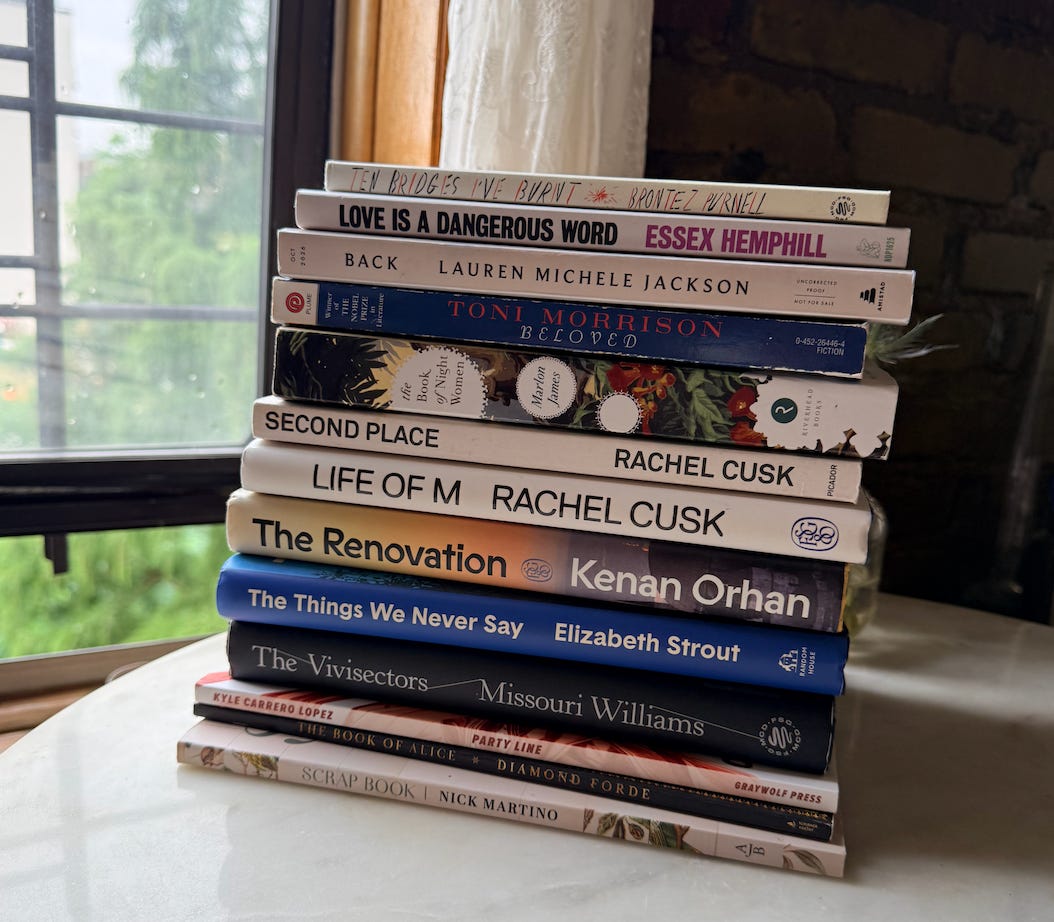
I began this month with The Sealey Challenge, which challenges you to read a book of poetry each day for a month. I failed miserably at that. I’m also reading everything on the Booker Prize 2026 Longlist, so clearly something had to give. Thankfully, the challenge is just about introducing poetry into your everyday life. You can also accomplish it by reading a single poem each day, which is what I switched to after my first week.
The poetry books I read from:
The Book of Alice by Diamond Forde
Love is a Dangerous Word by Essex Hemphill
Party Line by Kyle Carrero Lopez
Scrap Book by Nick Martino
Ten Bridges I’ve Burnt by Brontez Purnell
I’ll document my thoughts on The Booker Prize Longlist at a future date (though I’ve been ranking them on my Instagram feed), but as of now my favorite has been Marlon James’ The Disappearers. It’s been called a masterpiece. I agree. My interview with James will air on my podcast Feedback on 9/24. The others I’ve read:
The Things We Never Say by Elizabeth Strout
The Renovation by Ken Orhan
All Them Dogs by Djamel White1
The Vivisectors by Missouri Williams
Other books I read this month include:
Back by Lauren Michele Jackson (I’m a huge fan of Jackson’s writing and loved her previous collection, White Negroes)
Beloved by Toni Morrison (my ninth Morrison this year, and yeah, this is THEE American novel)
The Book of Night Women by Marlon James (incredible, a perfect back-to-back read with Beloved or The Disappearers)
Two Rachel Cusk novels, Life of M and Second Place
I love Second Place the most; it’s my favorite Cusk I’ve read so far. It’s so nasty and soapy. Everything I love in a novel! My review of Life of M is forthcoming on next week’s Feedback2, but it’s my least favorite novel of Cusk’s I’ve read so far.
Not pictured, as I finished it yesterday evening.
And potentially, a longer written piece here later this fall.
My biggest pet peeve is when people leave scathing reviews of books they dnf'd on Goodreads. Even if I didn't like the book I'm like, how can you know what this book was lacking if you didn't finish it?
I read 3-5 poems every morning, it's much more manageable and just as whimsical!