

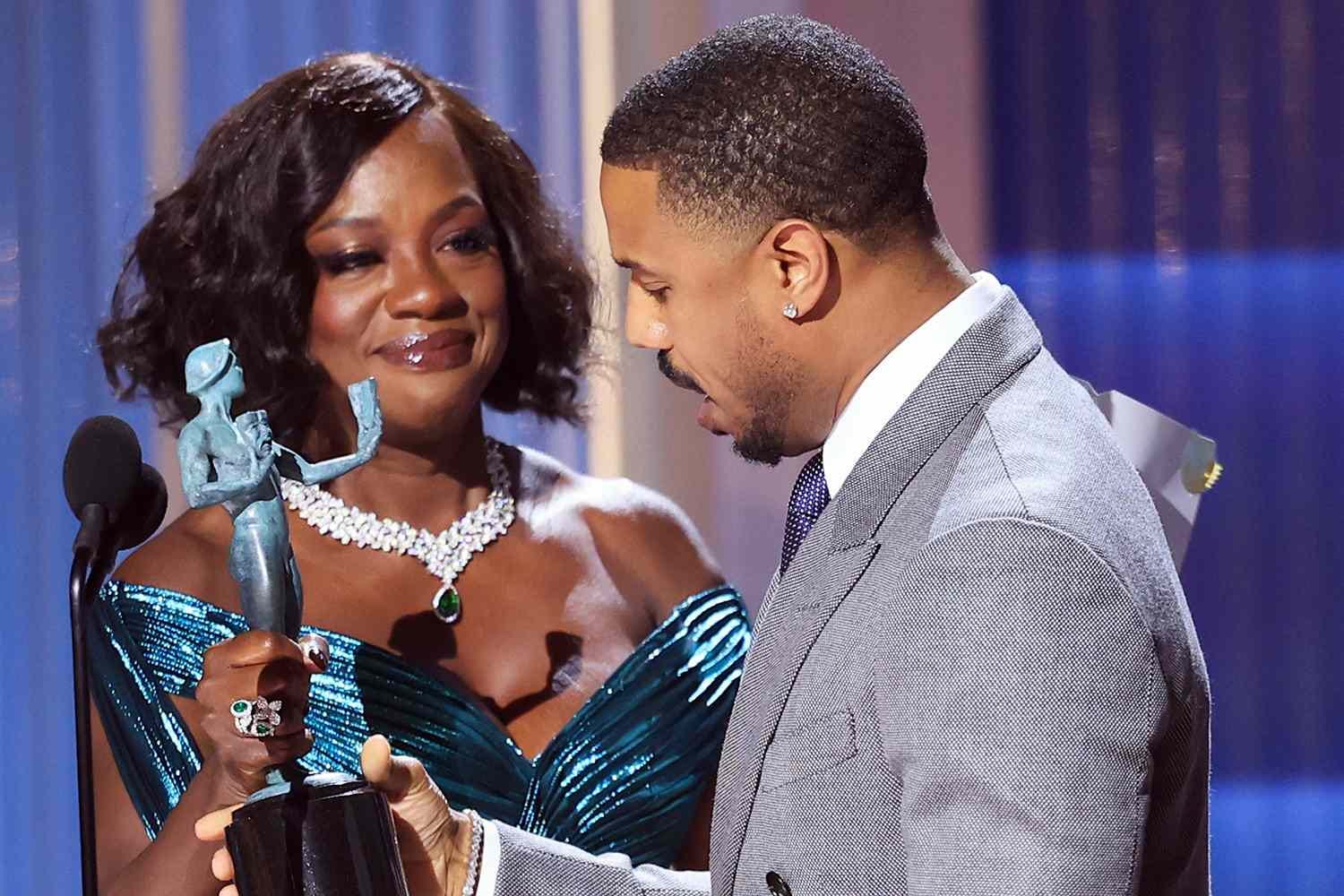
When Viola Davis shouted, “You are shining, Harold Loomis!” upon seeing that Michael B. Jordan won Best Actor at the SAG Awards (Idk what the fuck the Actor Awards are, I’m not calling it that) on Sunday, it sent many people to the internet to search for the meaning.
For the uninitiated, this was a reference to the 1984 August Wilson play Joe Turner’s Come and Gone. If you’re Black and you’ve done theatre, you’re very likely aware of Wilson, one of the greatest American playwrights to ever do it. And you’ve probably been involved in one of his plays. Davis’ first professional acting gig was Mattie in Joe Turner. Jordan’s Sinners co-star Delroy Lindo earned a Tony nomination for the role of Loomis in the 1988 Broadway production. Taraji P. Henson and Cedric the Entertainer star in a new Broadway revival that opens on March 30. We produced Joe Turner at my undergraduate alma mater, Loyola Chicago, directed by Professor Jonathan Wilson. Professor Wilson was a personal friend of Wilson’s, having produced many of his works, including Ma Rainey’s Black Bottom, Seven Guitars, and Fences. Sadly, Wilson passed away a month before our 2005 production, and I never got the chance to meet one of my favorite playwrights.
In the play, Loomis arrives at a boardinghouse in 1911 Pittsburgh with his daughter, in search of his missing wife. Loomis was kidnapped by Joe Turner and enslaved on a chain gang for nearly a decade. Due to his enslavement, he’s lost his “song,” and needs to find it again to start life anew. One’s song is a metaphor for their spiritual essence and personal identity, something that the descendants of enslaved Africans all possess, according to the play’s conjure man, Bynum. According to Bynum, African Americans’ embrace of a conservative, white Christianity is responsible for the loss of their songs.
In bell hooks’ 2004 essay collection, Rock My Soul: Black People and Self-Esteem, she addressed this phenomenon: “Using the Bible as a source for self-esteem, Black folks were able to counter the white supremacist insistence that they were less than human … since the intent of colonization and slavery was to strip the slave of all agency, religious experience that enabled Black people to identify with enduring the suffering of bondage while mainting one’s hope was life-sustaining.” hooks followed this with a warning: “In the world beyond slavery the radical relgiion of the slave began to change. As the Black church became in time an organized corporate institution, the religion of African Americans shifted from the liberation theology that had been so necessary for survival and settled in a conservative faith, one that relied on more fundamentalist interpretations of the Bible.” In his 1954 sermon, “Transformed Noncomformist,” Martin Luther King Jr. said of then-African American religious experience: “Be not conformed to this world: but be ye transformed by the renewing of your mind. Nowhere is the tragic tendency to conform more evident than in church, an institution which has often served to crystallize, conserve, and even bless the patterns of majority opinion. The erstwhile sanction by the church of slavery, racial segregation, war, and economic exploitation is testimony to the fact that the church has hearkened more to the authority of the world than to the authority of God.”
At the conclusion of Joe Turner, Loomis renounces the Christianity he embraced in enslavement and finds his song. Wilson’s stage directions of this moment read: “Having found his song, the song of self-sufficiency, fully resurrected, cleansed and given breath, free from any encumbrance other than the workings of his own heart and the bonds of the flesh, having accepted the responsibility for his own presence in the world, he is free to soar above the environs that weighed and pushed his spirit into terrifying contractions.” As he exits the stage, Bynum calls out to him, “Herald Loomis, you shining! You shining like new money!”
Davis’s reference to Joe Turner appeared more instinctive than intentional, but that doesn’t strip away its meaning. A week after the word “nigger” was hurled at Jordan and Lindo during the BAFTA Awards. The slur, uttered by John Davidson, a Tourette syndrome activist, launched a week of intense debates online and in the media, which I am not going to wade into, except to note that the BAFTA Awards were not televised live, and while Davidson was placed in the back so his uncontrollable outbursts could not be heard, the BAFTAs chose to place a mic near him. He uttered a homophobic slur during the show that was edited out of the aired broadcast. Akinola Davies Jr.’s cry of “Free Palestine” was also edited out. The slur against Jordan and Lindo was left in. Clearly, somebody felt that niggas say nigga all the time, so why bother editing it out? Never mind the context in which Black people have reclaimed the word involves artistic use and colloquial speech, not when you’re some of the only Black people standing on stage surrounded by the OG colonizers. I’m used to seeing white people use rap music as a defense of why Black people shouldn’t care when non-Black people use the n-word, but it was surreal to see people suddenly claim that because the word was used in the film Sinners, then Jordan and Lindo should’ve kept calm and carried on.
It’s why the existence of award shows like the NAACP Impact Awards matters, because it’s a celebration of Black art and artists in a space where they can exist without the spectre of racial abuse. The BAFTAs’ choice to air the slur unedited is why so many people are protective of Black creatives, from championing Sinners all awards season — after Variety published a critical headline about the film’s box office in April (”profitability remains a ways away”) that garnered backlash, even from white actors like Ben Stiller: “In what universe does a 60 million dollar opening for an original studio movie warrant this headline?” — to criticism of our lionized artists like Toni Morrison.
This week, The New York Times podcast Cannonball with Wesley Morris elicited backlash from an episode titled, “Don’t Make a Saint Out of Toni Morrison.”
The majority of the criticism lobbied was at the exclusion of a Black woman’s POV in the conversation, which included Morris, Parul Sehgal, and their editor, Sasha Weiss. Would Morrison herself be upset with this? In Claudia Tate’s 1985 book Black Women Writers at Work, Morrison says of white critics, “A woman wrote a book on women writers, and she has an apology in the preface in which she explains why the book doesn’t include any Black women writers. She says she doesn’t feel qualified to criticize their work. I think that’s dishonest scholarship. I may be wrong, but I think so, and I took the trouble to tell her that. I feel perfectly qualified to discuss Emily Dickinson, anybody for that matter, because I assume what Jane Austen and all those people have to say has something to do with life and being human in the world.” In theory, no, Morrison wouldn’t be upset with the idea of a Black woman not being involved. If the criticism itself was good, it wouldn’t particularly matter who gave it.
Unfortunately, the criticism in the podcast is poor and at times, vexing. From jump, Morris compares Beloved to the work of two white male writers: “It’s a hard book! Like James Joyce hard, like William Faulkner hard.” In that same Tate interview where Morrison encourages white critics to engage with her work, she also tells them to step their game up. She says, “It’s not a question of my not liking white criticism. I don’t like most of Black criticism either. Most criticism by Blacks only respond to the impetus of the criticism we were all taught in college. It justifies itself by identifying Black writers with some already accepted white writer. If someone says I write like Joyce, that’s giving me a sense of credibility I find offensive. It has nothing to do with my liking Joyce. I do, but the comparison has to do with nothing out of which I write. The criticism may read well, in fact very well, but it’s not about the book at hand. It’s merely trying to place the book into an already established literary tradition.”
The inclusion of a Black woman’s POV would’ve probably elicited some Black writers to compare Morrison to, instead of Joyce. I know it’s The NY Times, but is any potential new reader of Morrison gonna pick up Beloved because it reads like Joyce? Finnegan is no longer awake; he’s gone to bed. What else is going on!
Where the criticism of the alleged “sainthood” that has been heaped on Morrison offends is that it doesn’t engage with where the recent criticism of Morrison arose from. It came from people calling her “mean,” which led to defenses of a Black woman’s right to be prickly with her readers. It felt less like a bestowment of sainthood and instinct to protect a Black woman whose lionization feels long overdue, given the disrespect she endured in her lifetime. In January 1988, an open letter was published in The NY Times protesting that Morrison had yet to receive a major literary award. Months later, Morrison was awarded the Pulitzer Prize for fiction for Beloved. A novel, by the way, that Black critic Stanley Crouch referred to as “a blackface holocaust novel” in The New Republic. He continued: “It seems to have been written in order to enter American slavery into the big-time martyr ratings contest, a contest usually won by references to, and works about, the experience of Jews at the hands of Nazis.”
Crouch is referenced in the podcast episode for his critiques of Morrison, but there’s no mention of the fact that Crouch is generally regarded as a hater. He had incredibly conservative views in regard to Black art and also loathed Miles Davis’ fusion records (Bitches Brew is a masterpiece; he was tripping), gangsta rap music, and jazz’s shift to the avant-garde post Coltrane. Mentioning Crouch’s critique of Beloved, completely devoid of context, felt like cherry-picking criticism to support the podcast’s ultimate thesis.
The thesis being that Morrison’s books are traumatic and hard to read, apparently. When Weiss discusses Sula, she focuses on the fact that Eva burns her son Plum alive in the novel. Weiss says, “It’s not at all clear why, and it’s perplexing.” But Morrison explains Plum’s affliction clearly: “He began to steal from them then, take trips to Cincinnati and sleep for days in his room with the record player going. He got even thinner, since he ate only snatches of things at beginnings, or endings of meals. It was Hannah who found the bent spoon black from steady cooking.” Plum returned from the war deeply traumatized, much like Shadrack earlier in the novel, and had become addicted to heroin. Eva’s actions are out of love, yes, but they’re also selfish. The thin line between selfless and horrid, selfish love is what Sula explores.
I won’t claim to be a Morrison scholar. Before this year, I was only familiar with The Bluest Eye and the film Beloved. I resolved to read all of Morrison’s works this year, beginning with Sula, when I visited New Orleans for a weeks-long writing retreat in January. It took me a week to get through the book at first, rereading passages and notating the book, and consulting The Cambridge Companion to Toni Morrison. I don’t recall ever being moved by a book so much. When I reached the ending, and Nel realized that the love she most missed in her older age was not her husband’s, it was her friendship with Sula. When Nel sees leaves stirring in nearby trees, she calls out, “Sula? All that time, all that time I thought I was missing Jude. We was girls together. O Lord, Sula. Girl, girl, girlgirlgirl.”
I lost a best friend in October. A few years ago, Ted was in a surfing accident that paralyzed him. He was walking again within a year, defying the odds of doctors. We became even closer after that accident. He made me realize how important it is to cherish the time you have with the people in your life. To tell them you love them. I’m sad that I won’t have any more time with Teddy, but I have no regrets about the time we spent together. I always told him how much I cared about him. He always did the same. In the final moments of Sula, Nel regrets that she never told Sula how much she loved her before she died. But at Sula’s death, we, the readers, know that Sula’s final thoughts are of Nel. Upon dying, Sula thinks: “Well, I’ll be damned. It didn’t even hurt. Wait’ll I tell Nel.” Knowing that my friend’s final moments weren’t painful, that they ended on his own terms after five years of pain he couldn’t control, brought me peace in his loss. It brought peace to many of us, his family and friends, at his memorial in January, where many of the eulogies wrestled with Ted’s choice.
When I read the final page of Sula, I put the book down and cried. My intention for my trip to New Orleans was to finish the novel I’d begun after my apartment burned down in September. But I learned that the real reason I’d ended up in New Orleans was to grieve. Serendipitously, Sula opens with a quote from Tennessee Williams’ The Rose Tattoo, a play written for his lover Frank Melo, who lived with him in New Orleans. Sorry for being into woo woo shit, but it felt as if I was meant to read this book at this particular time in my life. I read the book again the next day. Every time I mentioned reading it at a party, there was always someone excited to discuss how much it moved them, also. In a moment when illiteracy is the weapon of our oppressors, how inspiring it is to be able to discuss literature! At parties!
That kind of emotional reaction to Morrison’s novels is what champions of her work want to protect. Morrison, like Wilson, took their duty as Black artists very seriously. Morrison in how she depicted African American life from slavery to the present, and Wilson in how his Pittsburgh Cycle, which chronicles the African-American life in the 20th century. They cared very deeply about Black people, and it’s why Black people care very deeply about them. It’s why their work is used to uplift the work of other Black artists, like celebrating Michael B. Jordan’s award win on the road to the Oscars, when he’d just endured a very public and embarrassing moment of racism. The alternate title of the Cannonball episode is, “If We Worship Morrison, What Do We Lose?” My question is, if you seek to discredit people’s relationship with her, what do you gain?
Thank you for this - beautifully written!
Gorgeous essay with so many saliant points. I would only push back on the Cannonball pod. There absolutely should've been a black woman on the pod, youre so right. And I think 2/3 of the attendants had a real grasp and deep love for the material. However, I thought the thesis/title of the episode was mostly ragebaity. They acknowledge that Morrison is still somehow underrated; and I think elevating her to some sort of deity undermines her genius for excavating, with surgical precision, the depths of our humanity. Thank you for this essay Ira. It was better than the podcast 😆