

You’ll forgive me if I thought I hallucinated the Democrats actually winning for once, because my brain has been on another planet since NBC announced a procedural adaptation of The Great Gatsby. In this adaptation, Jay Gatsby is “Det. Jay Gatsby, a devilishly charming investigator with a con-man’s gift for reading human behavior,” and Nick Carraway is now Nicky Carraway, “who was born to be a cop but dreams of becoming a writer.” I’m not sure how someone breeds the specific cop gene, but that’s one of the least objectionable things here
I know books are very in right now, but adapting The Great Gatsby into a modern-day crime procedural is such a distortion of F. Scott Fitzgerald’s text. For one, Gatsby isn’t particularly charming, he’s just rich. And he has no gift for reading human behavior because he’s an antisocial weirdo. In Nick’s initial encounter with Gatsby, who’s standing alone at his own party: “I was looking at an elegant young roughneck, a year or two over thirty, whose elaborate formality of speech just missed being absurd.”
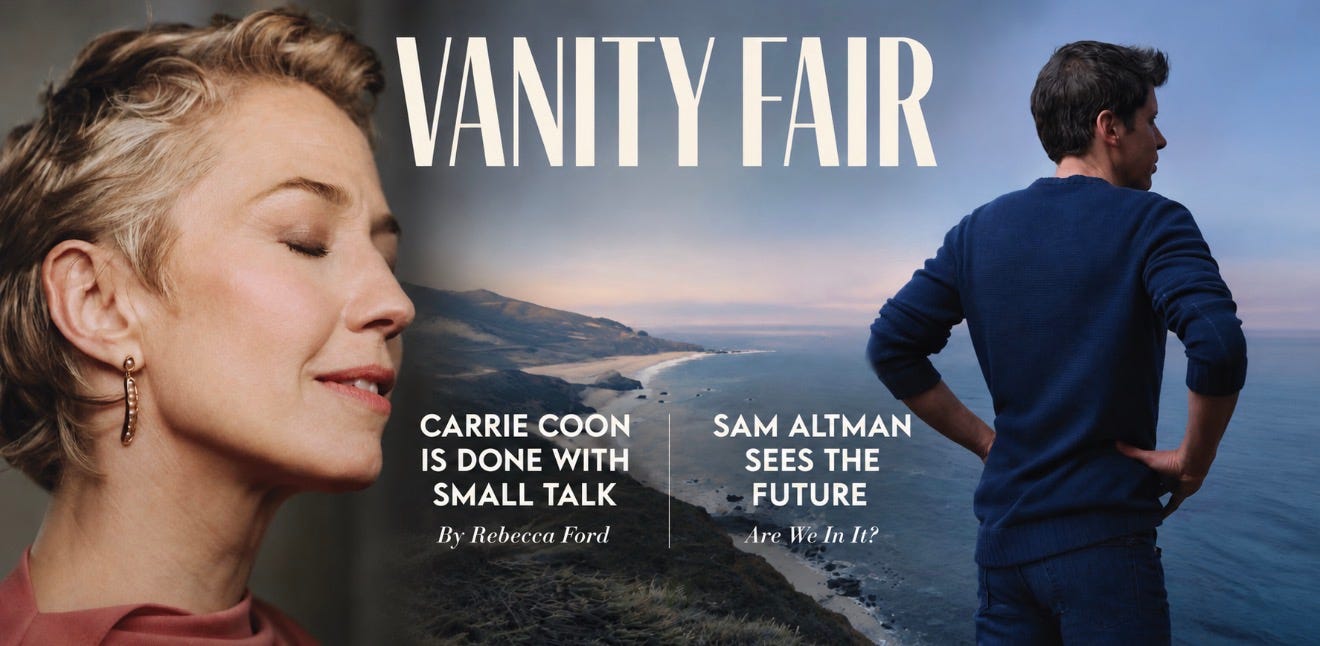
Fitzgerald doesn’t outright state how lonely Gatsby is, however. He uses the classic literary device of indirect characterization, where a writer lets a character’s gestures or behavior reveal something about them. It’s showing, not telling. It’s a common literary device used in magazine profiles. Like the recent Vanity Fair interview with Carrie Coon, where writer Rebecca Ford used indirect characterization to tell us that Coon is not self-aware.
In Friday’s “Carrie Coon is Done With Small Talk,” Vanity Fair meets Coon for tea at the London West Hollywood hotel. There is an immediate mention of the type of tea Coon is drinking:
“I don’t do small talk anymore. I’m not good at it,” says Coon, taking a sip from her own ginger tea—a blend she started having this restaurant make for her after getting hooked on it while filming The White Lotus in Thailand.
The Vanity Fair profile ends with this moment:
She does have one wish for the future: She’d like to do a comedy. “No one’s letting me do that. My family is surprised by my career because it’s just not the way I occurred to them as a person at all. People are expecting to meet a very serious and lugubrious actress that needs a lot of special drinks or something,” she says. While taking another sip from her custom, off-menu ginger tea.
It’s an indirect characterization of Coon as lacking self-awareness, pointing out that she’s very much capable of comedy, in fact. The final line created some backlash online, but I’m sure Coon is the kind of actress who can laugh at herself. And it’s a fantastic moment to include in a profile. You’d be a bad journalist not to juxtapose Coon’s words with her actions.
It’s reminiscent of the most infamous example of indirect characterization IN a celebrity profile: The New York Times’ 2010 profile of M.I.A. NYT reporter Lynn Hirschberg’s profile features this oft-quoted moment:
“I kind of want to be an outsider,” [M.I.A.] said, eating a truffle-flavored French fry. “I don’t want to make the same music, sing about the same stuff, talk about the same things. If that makes me a terrorist, then I’m a terrorist.”
Was this moment funny? Sure. Is it fair? Not entirely. M.I.A. was being interviewed at a restaurant for a magazine profile, and truffle fries were on the menu. Were they the only fries available? Did she ask for them specifically? The profile doesn’t tell us, but M.I.A posted an audio clip from the interview on Twitter to show that Hirschberg is the one who ordered the fries. Maybe she didn’t want to share, and that’s what pissed her off?
M.I.A. responded to the profile childishly by publishing Hirschberg’s number online, but still the profile does more to indirectly characterize the journalist than it does M.I.A. Like mentioning M.I.A. lives in Brentwood as a means to deflate her authenticity as an artist. Perhaps Hirschberg was right to be skeptical of M.I.A., time has proven her to be correct — M.I.A. did endorse Donald Trump and make a fucking song about it, after all — but still, truffle fries at a New York restaurant? They’re fucking everywhere… sometimes it’s impossible to get classic French fries.
The indirect characterization in Vanity Fair’s Coon profile is funny, but it should’ve been used in its cover story on Sam Altman. While editor Mark Giuducci’s profile has some pointed moments, it lacks bite. Even this moment, which could be read as a harsh framing — “Altman is finding it hard to shake a public image as unknowable, at best, and perhaps delusional about what constitutes an acceptable future” — is kinda weak when you’ve given him a glossy magazine cover. Altman won’t have to find it hard to shake his public image if you help him reframe it.
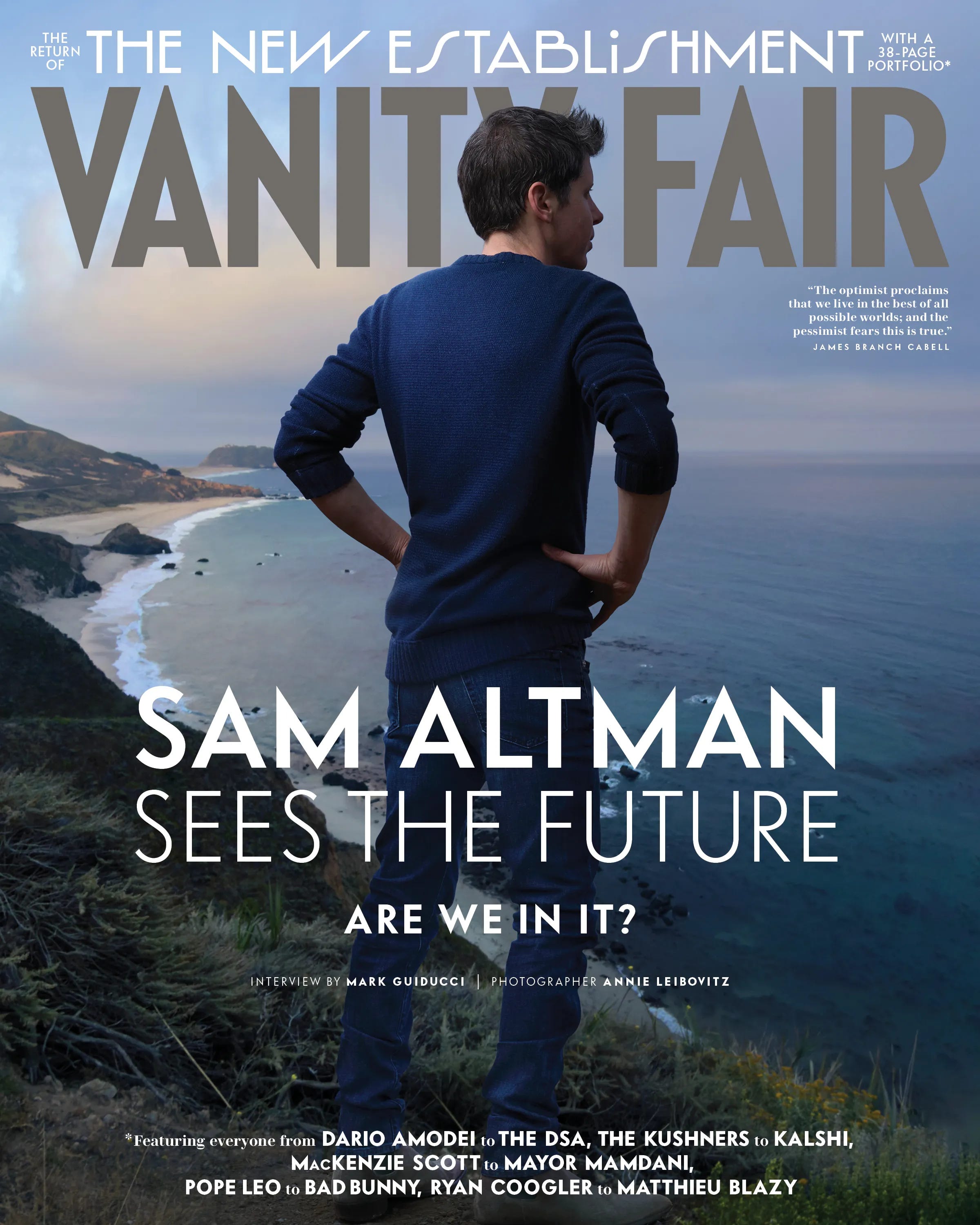
In an interview on Vanity Fair’s new podcast Fair Game, writer Jeremy O. Harris critiqued Guiducci for giving Altman a cover. Not surprising, since Jeremy admitted to drunkenly calling out Altman at the Vanity Fair Oscar Party earlier this year. Harris said that by allowing Altman and other tech billionaires to infiltrate cultural spaces, Vanity Fair is allowing Altman to change his public image to a respectable one.
It’s similar to the Jesse Plemons character in Alejandro González Iñárritu’s Digger, a film that received a lot of critical backlash, but I found it spectacular. In the film, Plemons (light spoiler) portrays Kenny Rockwell, the nephew of Tom Cruise’s Digger Rockwell. But we learn that Cruise isn’t actually Digger; he’s an actor portraying Digger in a play. The play, which lampoons Digger, allows the audience to laugh at the man responsible for plunging them into a global environmental crisis. And in turn, of course, feel good about Kenny Rockwell for spending his billions on a public good. Never mind that he also owns an AI surveillance company and is very likely just as evil as every other tech billionaire!
The film alludes to this, however, by using Bertolt Brecht’s theory of alienation in theater. By making the central story a play, Iñárritu’s film removes the audience’s ability to empathize with Digger. By highlighting the stage, props, and set changes, it makes the audience aware of the artifice of the film. Brecht wanted his audiences to riot in the 1930s and Iñárritu wants similarly of his audiences now. You should fucking hate tech billionaires. Or at the very least, be extremely skeptical of them.
In the profile, Altman claimed that he met Andrew Garfield while Garfield was filming Artificial (where he portrays Altman), and they both waved at each other. In a GQ interview this week, Garfield said the claim was bullshit. “I’ve never waved at Sam. I’ve never seen him.” It would have been far more interesting to include Garfield’s repudiation of Altman’s account in the Vanity Fair profile. It would’ve shown that Altman is a liar who is very concerned with characterizing himself as a person that other celebrities like.
Can a celebrity profile expose a powerful subject when the magazine is also invested in celebrating their power? Let’s talk about indirect characterization once more: the ability to point out contradictions in Carrie Coon’s words and behavior, and the inability to do so with Sam Altman. It says a lot more about Vanity Fair than it does about anyone else.
Who is her agent, I need Carrie Coons to be cast in Traitors as a naturally funny faithful to launch her as advertisement for a mid-budget feel-good comedy!!!
Carrie Coon is very funny, she should do comedy