

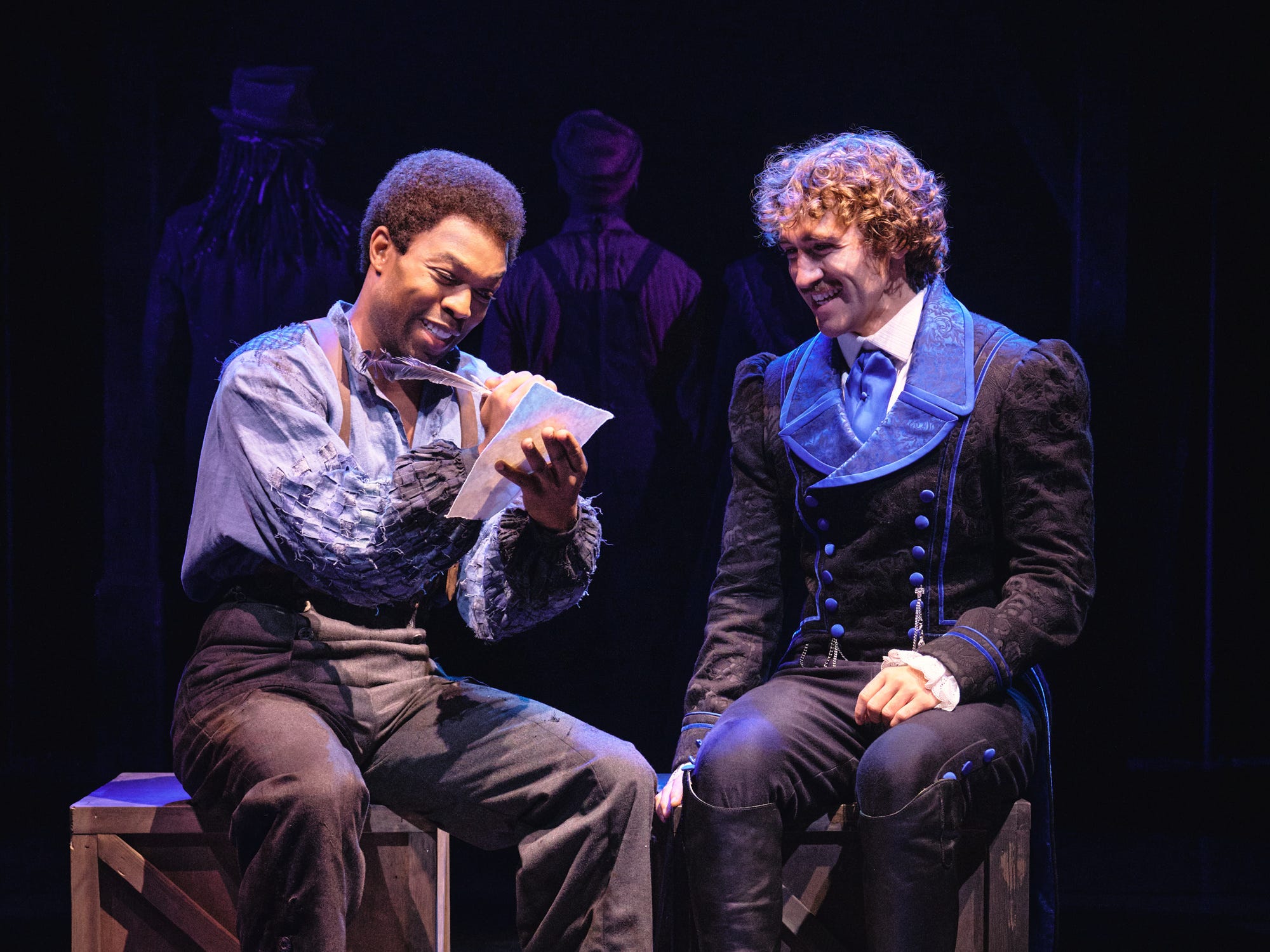
In 1946, Disney released Song of the South, a live-action and animated musical about Uncle Remus, a former slave who now works on a plantation during Reconstruction and tells fables to white children. At the time, the NAACP slammed the film in a statement that said, “In an effort neither to offend audiences in the North or South, the production helps to perpetuate a dangerously glorified picture of slavery … [the film] unfortunately gives the impression of an idyllic master-slave relationship, which is a distortion of the facts.” The film had its defenders. Even Black ones. The West Coast Editor of the Pittsburgh Gazette, Herman Hill said the film would provide “inestimable goodwill in the furthering of interracial relations” and referred to critiques of the film as “unadulterated hogwash symptomatic of the unfortunate racial neurosis that seems to be gripping so many of our humorless brethren these days.”
A century later, the spirit of this debate continues with Todrick Hall’s new slavery-themed musical. Hall has been called out for a perceived exploitation of the trauma of slavery to tell an interracial romance between an enslaved man and a white slave owner. Hall also has his defenders, and for every Sydney Sweeney who has been photographed attending the show, there are also other Black celebrities in attendance, like Whoopi Goldberg, who also provides a pre-show recorded voiceover thanking audiences for attending an original musical from a Black and gay artist.
To form my own educated opinion, I attended the show on Tuesday to witness Hall’s new contribution to the Black theatrical canon. Turns out, I had more interest in educating myself than Hall. Midnight is not only ahistorical, but it’s embarrassingly naive. But to accuse Hall of willingly inflicting the trauma of slavery on audiences is giving Hall too much credit. He does not appear to be cognizant of anything concerning race in America beyond simplistic platitudes like “can’t we all get along” and “interracial queer love matters!" The musical is so trite that it makes Macklemore’s “Same Love” feel like the brick hurled at Stonewall.
Hall’s play has been compared to Jeremy O. Harris’ Slave Play, which makes sense if you’ve only seen the discourse and neither play. While there is the question of Harris repurposing racial trauma on stage, particularly in its polarizing final act, there is no comparison between Harris’ subversive play and how Hall makes slavery seem palatable. Harris’ intent for Slave Play appears in its production notes, where he writes, “You should not work to make the audience comfortable with what they are witnessing at all.” By contrast, the fact that everyone in Midnight can sing DOWN, that the songs are incredibly catchy (I was humming one during intermission), and that the costumes and set are so reminiscent of Wicked, there is no friction on stage whatsoever to remind audiences that we are indeed watching a play about slaves on a plantation.
Furthermore, the anachronistic details in Midnight contribute to its fictive nature. Slaves move freely about the plantation like it’s a resort. They frequently look their white owners in the eye and even talk back. Rail, presumably a field hand, is put to work at a dinner party, taking on the duties of a house servant. There is also a general lack of understanding of how enslaved people were treated during this era. They were property and performed jobs for their enslavers. In the opening of the musical, Rail’s father is shot and killed by his enslaver when he refuses to give up his newborn son to be sold. Rail’s parents seem utterly shocked that their child could be sold, which is something that would’ve occurred regularly. Never mind that a newborn would be unlikely to be ripped from his mother’s arms seconds after birth. Though enslavers legally had the right to, a child would not be separated from their mother through sale or hiring out until the child was weaned or reached early adulthood. Never mind that an enslaver would also be unlikely to shoot his own property before disciplining him.
At many times in the play, the threat of violence against Rail is done by Richard’s brother, a man with no legal rights to Rail. This general disregard for another person’s property would be seen as a crime. The fast and loose representation of slavery by Hall makes it impossible to get a hold of the play’s timing even, until someone mentions that the setting is 1863. Hall’s play at times feels more appropriate for a post-Reconstruction setting or even the Jim Crow era South, where Black people had more autonomy than when they were enslaved. Instead, it feels as if Hall didn’t even bother to ChatGPT the Civil War-era South.
That Midnight is so ill-researched comes across not only as lazy, but as disrespectful to Hall’s enslaved ancestors as well as the audience. At its worst, it borders on propaganda. Propaganda for what? That brings us to the central romance in Midnight. Rail’s enslavers are poor and in search of a wealthy family to marry into. Enter Richard, a wealthy landowner who somehow does not possess slaves because he’s a “good” white man. Never mind that his engagement to Scarlett, one of Richard’s enslavers, would transfer ownership of Rail to Richard. This detail is ignored as Rail is hired out to build the future house where Richard and Scarlett will live (and Rail will presumably be enslaved at).
The script tangoes around this arrangement, so as to give Rail autonomy where it feels like he is building this house of his own free will. But he is not. Richard is, for all intents and purposes, Rail’s owner. Which makes this not just an interracial romance between an enslaved Black man and a white man. It is a romance between an enslaved Black man and his enslaver. It’s the Absolut Vodka gay pride float version of Thomas Jefferson and Sally Hemings.
Perhaps the most disappointing aspect of Rail and Richard’s relationship, besides a very absurd scene where Richard teaches Rail how to swim chile, is that Richard teaches Rail how to read. And with his newfound ability to read and write, Rail opts to… merely exchange love letters with Richard. It was illegal for enslaved people to learn to read and write. Southern slave states enacted comprehensive anti-literacy laws post-1740 and 1834 and passed even harsher restrictions after the Nat Turner rebellion in 1831. Enslavers feared that literacy would allow enslaved people to read abolitionist literature and challenge the system of slavery.
The literary heritage of African-Americans belongs to autobiography. In “The Site of Memory,” Toni Morrison writes, “In this country the print origins of black literature were slave narratives. These book-length narratives, of which well over a hundred were published, are familiar texts to historians and students of black history. Whatever the style and circumstances of these narratives, they were written to say principally two things. One: This is my historical life - my singular, special example that is personal, but that also represents the race. Two: I write this text to persuade other people - you, the reader, who is probably not black - that we are human beings worthy ofGod's grace and the immediate abandonment of slavery.”
For an eslaved Black man to learn to read and write post in the Civil War era- South — but to possess no desire to teach other Black people to read and write, or to transcribe the horrors he endured while enslaved, is not just unbelievable; it's a flippant disregard of him as a three-dimensional character. Therein lies my singular problem with Midnight. At no point does Rail feel like a real character. His existence is only to serve this romance that Hall was intent on writing. Rail does not seem to think about his own autonomy at any point in the musical: his only concern is railing a white man.
In his review of Slave Play, critic Vinson Cunningham wrote for The New Yorker, “Nobody, even at this relatively late date in the history of forced or free American race-mixing, knows exactly what to do with the idea—or, worse, the reality—of a black body and a white body coming together. The problem is a superfluity of meaning. Sex between the races means rape and reconciliation, repression and release, assimilation and radical rejection, inculcation into one faulty set of values and freedom from another. Its participants are revolutionaries or self-haters, or both, and they are evidence of an old stain but also hints of a world to come.”
It isn’t the fact that I object to Hall’s attempts to depict this romance. I am not a person who believes in censoring art. But a story like this belongs in the hands of an artist who would approach its subject matter critically with a point of view and an intent beyond bringing audience members to tears for the alleged bravery of depicting this story. To witness Midnight amongst a diverse crowd of theatregoers (yes, there were many Black people in attendance of various ages, despite what social media would like you to believe) was such a discomforting experience. Hoots and hollers every time a cast member hit a power note, and a feel-good sense that “a change is gonna come” (literally uttered in a song, by the way) and that enslaved people might ascend to “Black Excellence” (the second act opening number) is all Hall seems capable of wanting for the audience and, ultimately, his art.
I cannot continue then, to discuss Hall’s play without discussing its second act, which has been called “daring” by critics like Dan Rubin in Slant. Rubin argues that it would be unfair to give away the twist, but it’s the twist itself which further cements how out of his depth Hall is to depict this story.
At the conclusion of the first act, after Rail sings, "I wish for them to be us,” the clock strikes and sets the scene for a dramatic act two reversal. The second act presents a race-reversed South where Black overseers enslave the white characters. While it’s commendable for an original musical in this age of audience-safe revivals to attempt such a bold twist, I was left wondering what it serves to put white people in the shoes of enslaved Black people?
While the shocking twist does put Midnight at least in partial conversation with Slave Play, it’s an uneven conversation at best. Regarding Slave Play, critic Sorya Nadia McDonald wrote for Andscape, “The squeamishness surrounding anything that reminds white people of their whiteness. Every white person in Slave Play is trying to outrun their whiteness, even the therapist Patricia. It is a delightful send-up of the way well-to-do, overeducated white people discuss racism as though it has nothing to do with them personally.”
Midnight has no such aims of reminding white people of their whiteness. The twist, for the record, is not as freshly original as one would assume. The concept of Black people enslaving white people has been a subject of speculative fiction for years. Octavia Butler’s 1980 novel Wild Seed examines how absolute control corrupts both the ruler and the ruled in its depiction of the East African Doro as an eslaver of all races. It confronts what it would mean for a member of a subjugated race to hold dominion over others. But because only Raily is aware of the race swap that occurs in the second act, the white characters are not even forced to confront what life as an enslaved person would be like. It is only the audience who is cognizant of this, and as it is presented, I am highly skeptical of the ability for any white person to see this second act of Midnight and genuinely empathize with the horrors of chattel slavery.
The second act’s race swap reminds me of Jean Genet’s 1958 absurdist play The Blacks. In it, a troupe of Black actors reenacts the rape and murder of a white woman before a mock court of Black actors wearing white masks. Genet intended to hold a mirror up to colonialism, white supremacy, and racial performance, and he intended it for white audiences. In his production notes, Genet stated that if The Blacks were performed before a Black audience, a white spectator should be seated in the front row and illuminated by a spotlight. He wanted white people to be uncomfortable. By contrast, Hall’s work seeks only to draw sympathy and tears from a white audience. Both are in service of entertaining white guilt.
There is one thing very historically accurate about Hall’s musical. Narrative of the Life of Frederick Douglass, an American Slave sold 11,000 copies in two years. Solomon Northrup’s Twelve Years a Slave sold 27,000 copies in two years. Other slave narratives sold just as well. The hunger for slave stories has always existed in America, which is why it’s no surprise that Midnight is selling out shows despite its hefty price tag.
Slave stories, used to confront white readers with the ills of America. Midnight has no such aims. The closing finale features the actors reading historical facts about the 13th Amendment and Loving v. Virginia and how, in the future, a love like Rail and Richard’s could finally be possible. Midnight is not a slave narrative; it’s not even Rail’s narrative. It’s the perhaps well-meaning, but wholly naive narrative of an artist who wanted to tell a story about the ability of love to cross racial boundaries and used one of the most horrific moments in American history as a backdrop.
When Joel Chandler Harris created the character of Uncle Remus, before he sold the story to Disney, he depicted a formerly enslaved man who “has nothing but pleasant memories of the discipline of slavery,” novelist Alice Walker wrote in 1981 for Southern Exposure. Harris worked as a newspaperman at the Turnworld Plantation as he created these stories. Harris asked Mr. Turner, Turnworld’s owner, why he never worried about runaway slaves. To which Turner responded, “The people who treat their negroes right have nothing to fear from them.” I suppose in Hall’s mind, the best way to disarm an enslaved man with the dangerous ability to read and write is to give them a white slave owner to love. But he’s a good white man, Savannah.
This was a fascinating critique, Ira!
Going to see this in a week or two. The way I read this, agog! This is an excellent review.