

My new podcast, Feedback, launched recently. Please subscribe to our YouTube channel and check recent reality TV-related episodes! Last week, I chatted with Gibson Johns about how Bravo fandom became a full-time business. This week, I chat with Tell the Bees about the incel-ification of the internet and obsessive fandoms.
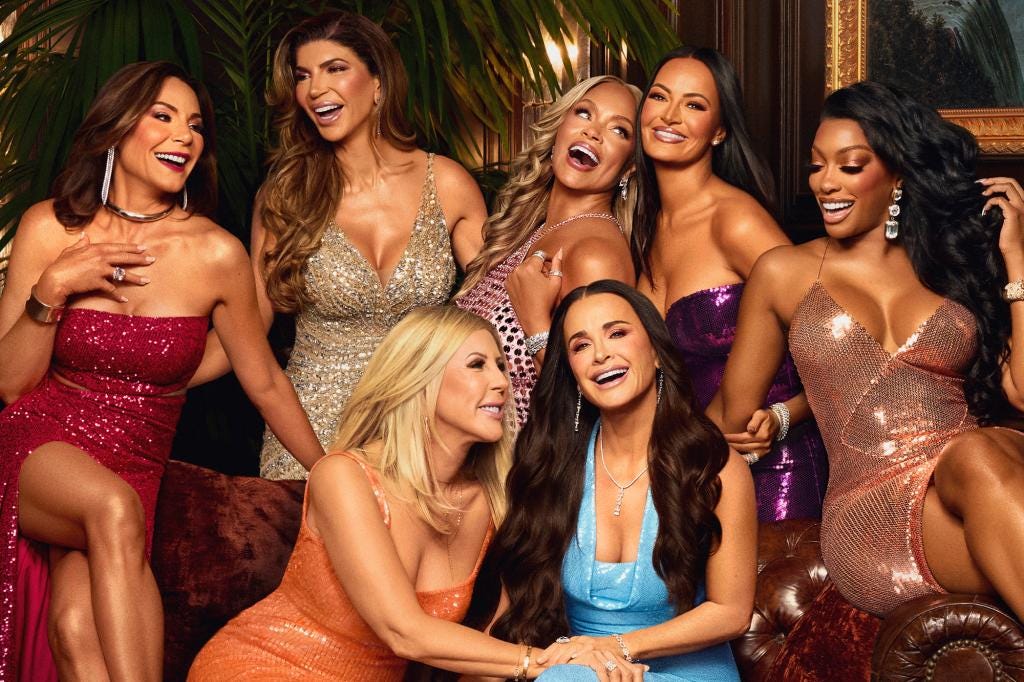
Smart people watch Real Housewives. But does that make Real Housewives smart?
“The Real Housewives franchise is the most important anthropological documentation of modern women that we have,” was a recent take on the internet series Subway Takes. No offense to the guest with this take, but this is far from a hot take. It’s not even a lukewarm one at this point. Real Housewives has been discussed seriously by critics for over two decades. In 2014, academic and critic Camille Paglia compared the franchise to the work of Douglas Sirk and Rainer Werner Fassbinder: “Cohen has so altered and redeemed the pop culture landscape—which had been suffering for years from snide snark and pseudo-hip cynicism—that he should be acknowledged as a genuine auteur, like maverick film directors. His tastes, instincts, and sensibility now suffuse a staggering number of highly successful TV projects. Not since the radical gay German director Rainer Werner Fassbinder revived and recast Douglas Sirk’s ‘women’s pictures’ during the 1970s has a single individual so boldly rescued a waning genre and given it such splendid new life.”
In 2024, professor of sociology Laura Grindstaff referred to the series as a bit of accidental anthropology: “The predictability of the format – strong women characters in luxurious settings navigating life events that generate conflict and drama – coexists with the unpredictability of exactly how each character instigates, responds to and manages these conflicts. Viewers enjoy parsing out those moments when authentic or 'real' emotion breaks through, in seeing the blend of 'scriptedness' and spontaneity unfold, in vicariously enjoying glamour and opulence, in following the arc of a favourite character.”
Real Housewives, while unscripted, has too many formulaic beats to be considered a genuine “anthropological documentation of modern women.” At least, the women on television. The real anthropological study related to the housewives lies directly with the audience. The women, gay men, and now a small minority of straight men who watch the series as it has exploded into mainstream relevance1. If future civilizations2 want to study society in 2026, looking at Real Housewives would be useless. But studying the fans of Bravo? Studying how friend groups deal with conflict after years of consuming Bravo? Studying how celebrity culture has changed due to our proximity to Housewives and their overwhelming desire to perform for our favor? Studying how fans describe Real Housewives as an “anthropological documentation” to justify their obsessive interest in being entertained by women like they’re spectators at the Colosseum? That would be a much more compelling case study.