

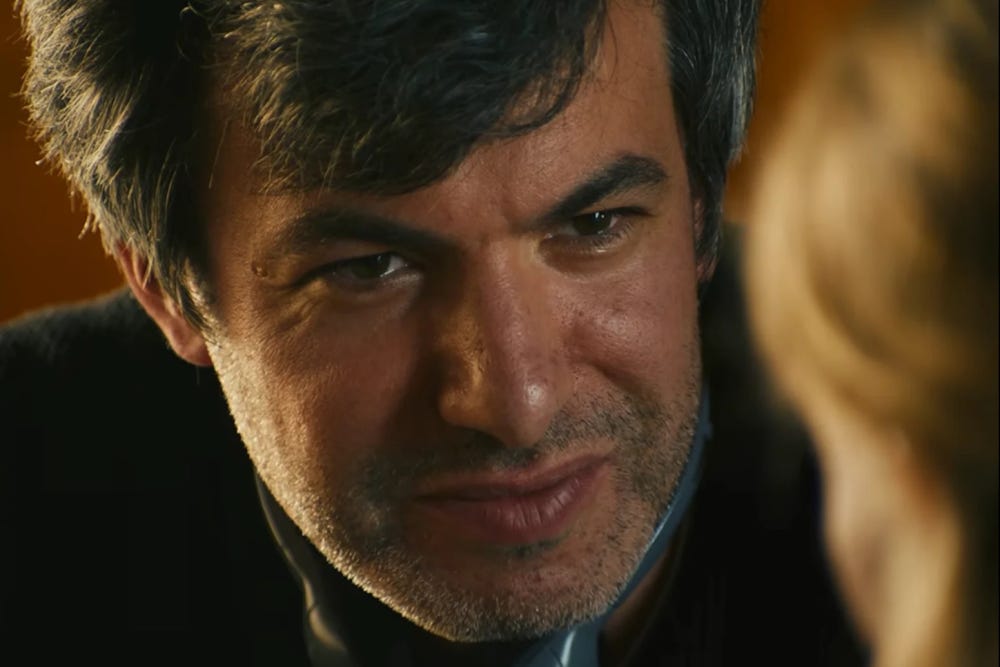
This essay includes spoilers for You Can See Everything and Life of M.
In the good old days, a dubious documentary about a celebrity’s life would be followed by a sit-down with Oprah. Like in 2014, when OWN aired the docuseries Lindsay, which followed Lindsay Lohan’s post-rehab recovery. By the series’ third episode, Lohan was chronically late, canceling photo shoots, and refusing to let cameras follow her. This prompted Oprah to fly to New York and confront Lohan on camera. “You need to cut the bullshit. You really do,” during their confrontation. But Lohan maintained she was sober until an interview in the finale, where she revealed to Oprah that she had privately relapsed during filming.
The series was heavily criticized as exploitative given the conflict between maintaining sobriety and participating in reality television. It was also critiqued for a lack of well, reality.
In Nathan Fielder’s Elizabeth Holmes documentary You Can See Everything, co-directed with Lance Oppenheim, no such sit-down interview exists to explain to the audience what actually unfolded behind the scenes while the cameras were rolling.
The film was born when Fielder and co-director Lance Oppenheim attended a show at Hollywood’s Magic Castle. Fielder was already aware that Holmes had approached A24 to shoot a documentary in her home with her partner, Billy Evans, and their two children. Oppenheim told W Magazine in October, “We were in the close-up magic room, and they asked for a celebrity name from the audience. Someone shouted ‘Elizabeth Holmes,’ and we took that as a sign.”
Soon after, Fielder and Oppenheim commenced filming in Holmes’ house. From the jump, Holmes has the upper hand here in a way that Fielder’s usual unsuspecting subjects in series Nathan for You and The Rehearsal have never had. New York Times reporter Amy Chozick, whose 2023 interview with Holmes plays a central role in You Can See Everything, recently addressed the absence of Vanessa, Holmes and Evans’ Salvadoran nanny, in the film: “She was nowhere to be seen. Without her, the couple comes off as harried multitasking parents, Ms. Holmes literally rocking the baby with one foot.”
Chozik also attacked the idea that she misquoted Holmes in 2023, which becomes a recurring storyline in the film. According to Chozik, “The documentary’s postscript says Mr. Fielder eventually got in touch with me, and that I stood by my story but didn’t provide evidence supporting the quote. That’s not exactly what happened. I never discussed the disputed quote with Mr. Fielder. I referred his inquiry to The Times, which has stood by the reporting.” Chozik isn’t the only person previously involved with Holmes to raise concerns about the veracity of Fielder’s film. On PJ Vogt’s podcast Search Engine, Theranos whistleblower Tyler Shultz explained how Holmes’ legal team threatened his career and finances.
What he found most troubling about the documentary is that it left people rooting for Holmes. In fact, the very nature of the film’s “big twist” has encouraged many people to “go in blind” to the film so as not to spoil themselves. The film is more interested in crafting a compelling narrative than it is in the truth. Why else would it include riffs on Vertigo, down to recreating its famous car scene and its Bernard Herrmann score?
The Vertigo riff is dialed all the way up when Holmes goes to prison, and Amanda Seyfried appears to assume the role she played in The Dropout and recreate scenes between Fielder and Holmes that he doesn’t have on film. If your mind goes to Jimmy Stewart and Kim Novak in Hitchcock’s masterpiece during these scenes, don’t worry, you were supposed to. Why else would Fielder include a moment where he writes in a letter to Holmes that he’s single now, then follow it up with scenes where you almost expect them to kiss? I mean, the lingering on Holmes’ partner Billy Evans’ dick made me wonder if Holmes and Evans downloaded Feeld before they asked Fielder to move in with them.
After the film’s conclusion, you’re left feeling like Fielder’s documentary project failed, and he was duped by Holmes, just like so many men before him. But this is Nathan Fielder. A master manipulator himself. As we’ve seen in The Rehearsal, Fielder doesn’t just document people: he constructs elaborate scenarios where their behavior becomes material for his own narrative. His performances of awkwardness are only possible because of the extraordinary amount of control he has over his constructed scenarios.
Fielder isn’t dissimilar from Rachel Cusk, the literary world’s anointed queen of autofiction, who, if you ask her about it, says she absolutely hates the word autofiction.
In Cusk’s Outline, we follow recently divorced writer Faye as she travels to Greece to teach a writing class. In The New York Times’ review of the novel, Heidi Julavits wrote: “The narrator of Cusk’s lethally intelligent novel is a cipher who inspires other people to confess. In her presence, they divulge stories about their wives and husbands and mistresses, their parents and children and careers. The narrator’s bio, meanwhile, remains faintly sketched.”
To me, Cusk is not a cipher. The narrator makes a deliberate decision to let the people around her speak, listening to their confessions and taking their insults (”you’re a lousy teacher,” a student tells her at one point) or describing them as menacing, like when she describes the neighbor on her plane to Greece, who later holds a knife near her on a yacht. Never mind that this man has expressed romantic interest in Faye, she is not interested, and yet she continues spending an inordinate amount of time with him. Is she toying with him? Is she toying with all of the people she interacts with, letting them ramble on so as to indict themselves? And with Faye being the sole narrator, how can we trust anything that she’s told us?
Similarly, how can we trust anything that Fielder has shown us in You Can See Everything? He didn’t even ask her about the damn fake voice! When Seyfried accuses Fielder of editing the documentary in a way that protects Holmes, is this a genuine concern, or is this part of the narrative Fielder has constructed of “documentarian falls for his subject’s wiles?” As it turns out, You Can See Everything isn’t actually about Holmes. It’s about Fielder. Fielder knows about the public perception of his manipulation tactics. He knows that people find him cruel. That people wonder if he’s on the spectrum or feigning to be. That people wonder if he’s as sexless as he comes off. If anything, You Can See Everything manages to place Fielder in the middle of a thrilling will-they-won’t-they romance. I left the film and wrote in my Letterboxd review, “I wanted Nathan and Liz to kiss 🥺.”
The confusion as to who the protagonist of You Can See Everything is reminds me of Cusk’s latest novel, Life of M. Purported to be a tell-all about her friendship with Natalie Portman, it caused a similar online frenzy to the Holmes documentary. People who’d never read a Cusk novel before were talking about literary fiction this summer! Bitch, I loved it. Even if I didn’t ultimately love the book. But not because the book promised to reveal intimate secrets of Portman and then didn’t. Portman is not the protagonist of Life of M, Rachel Cusk is.
Or rather, the narrator is a stand-in for Cusk. The opening paragraph of Life of M reads:
A little while ago, I told the actor M that I was thinking of writing her autobiography. She liked the idea. She’s a good sport. Would you just make it up? she said.
Later, when Cusk’s narrator finishes her autobiography, M doesn’t like the results and confronts the narrator:
I don’t like the way you portray me, she said. Actually, it’s hurtful.
But it isn’t you, I said. It isn’t anyone.
She looked at me coldly.
You’ve made it seem like I lack humanity, she said. You’ve made it seem like I’m unable to love.
But you’re just playing a character, I said. The character was invented by me. So if that’s true, then it’s me it’s true of. I haven’t even googled you. I know nothing about you.
The thing that hurts M the most about her depiction is how she’s been portrayed as lacking humanity. Unable to love. It’s not unlike the pranks that Fielder places people in to exploit their emotions. In The Rehearsal, when Angela confronts him, she says, “You’re a liar. Because if this were real, you would have some sort of emotion. Instead of standing there like a rock.”
How fortuitous then, that the story Fielder has crafted in You Can See Everything features him wondering if Holmes and Evans’ odd love story is genuine. No longer a rock, we finally see Fielder as his most empathetic.
In 2020, while in conversation with actress Alexa Demie on The A24 Podcast, Fielder explains to Demie why he’s not a good actor: “I've never been good at doing… you're like a real actor because you, I think, can take… the character you play is not like you, but you can just take it and be so convincing. I'm not as much like that.” Demie responds, “I think you are, though.”
Fielder’s humility with regard to his acting skills is yet another thing he has in common with Cusk. In a 2023 New Yorker article, Cusk says, “I don’t think that I write autofiction, though I admire the people who do, and essentially wish that I did. I think it’s an evolution beyond what I’m doing. I’m perhaps stuck in the past, trying to work out the past. I don’t think I’m in any way as free as the writer of autofiction.”
Cusk says she doesn’t write autofiction. Fielder says he’s not an actor. To quote Oprah, “So, what is the truth?”
Fielder has been playing with the audience’s assumptions of what we expect a narrator to be in the Rehearsal and previous shows like Nathan For You, but especially with this film. Documentaries in particular normally have a neutral, detached narrator and so we are expecting that in this film, but Fielder is not giving us that at all. Therefore coming in with some familiarity with his work, I knew he was going to play games. Did I expect reenactments with Amanda Seyfried? No. And even less so her getting directly involved in the story on some level.
He is definitely acting even if it isn’t a scripted role, just as Amanda is too. What makes this film so interesting to watch is that it plays with the boundaries of what you will tolerate in a documentary and when does it become fiction. For that reason alone I know that this isn’t getting an academy award nomination in the documentary section. But as a film? It is just the kind of thing that makes you think on all levels. The purported subject of the documentary is a grifter, but then you wonder part way through if you have directly helped her grifter boyfriend / partner profit from this and whether or not you feel comfortable with that.
There are just so many levels that it demands rewatching even after you know the twists.
Ooo chile lemme prop my feet up and lock in 👀