

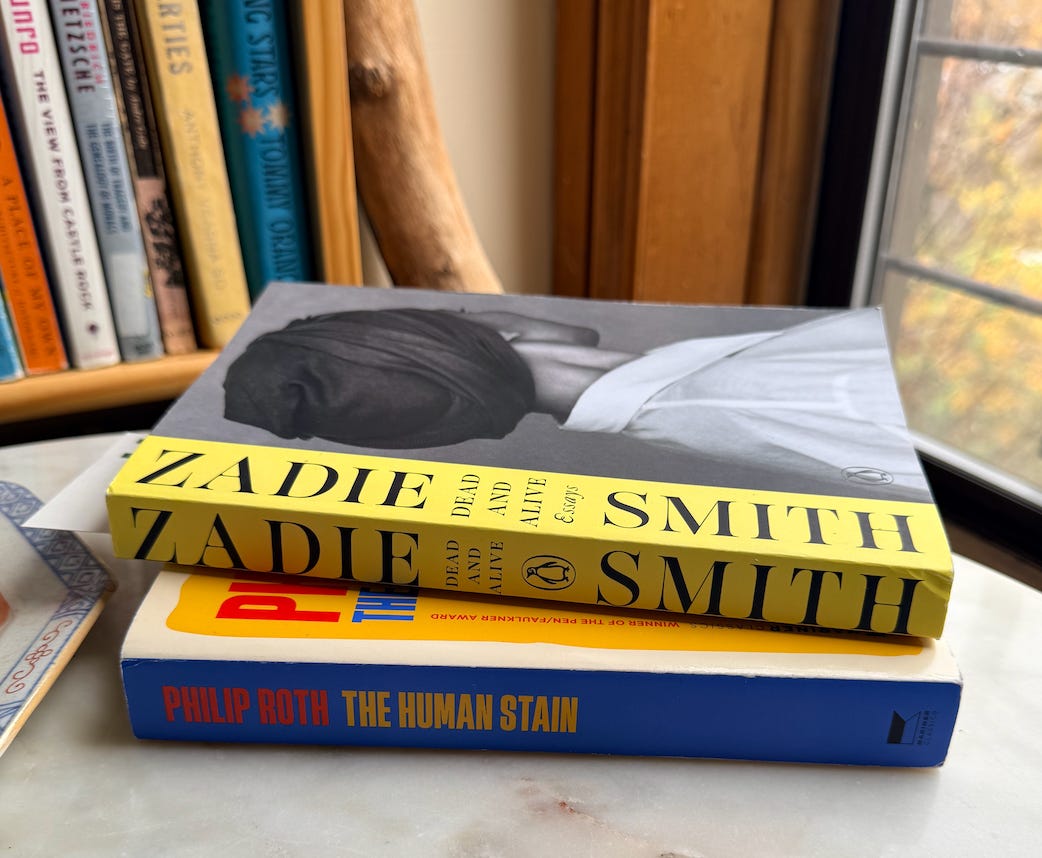
I’ve always been the type of reader who underlines the hell out of his books and scribbles in the margins. It comes in handy. When I interviewed Marlon James about The Disappearers, I re-read all of the passages I’d underlined and annotated to prepare.
I’ve decided that rather than simply list the books I’ve been reading, I’d rather start sharing what’s been sticking with me each week. Expect The Frank Index now to include passages from novels, essays, and whatever else happens to cross my desk, along with some thoughts about why I marked them up in the first place.
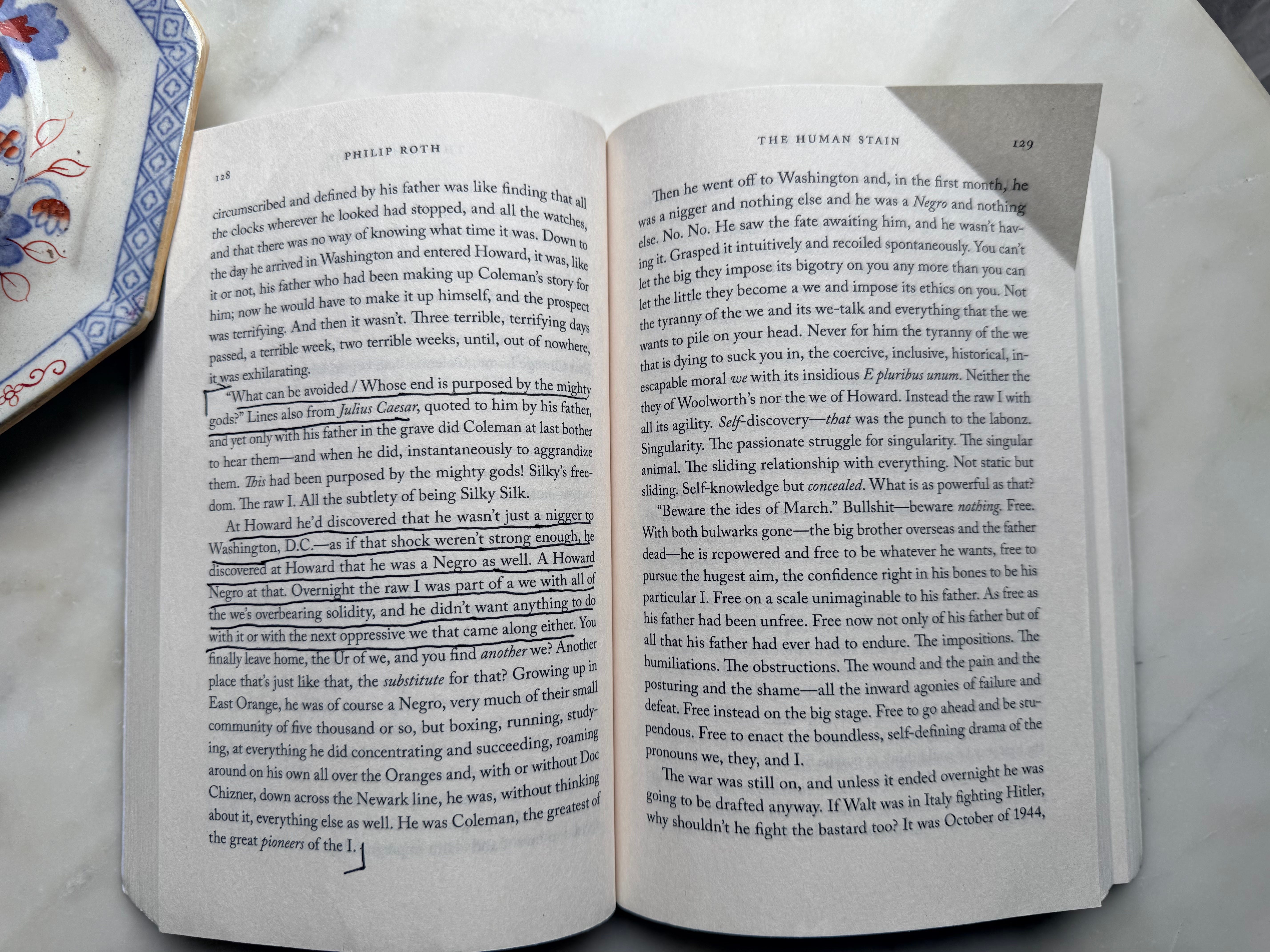
The Human Stain by Philip Roth
“What can be avoided / Whose end is purposed by the mighty gods?” Lines also from Julius Caesar, quoted to him by his father, and yet only with his father in the grave did Coleman at last bother to hear them — and when he did, instantaneously to aggrandize them. This had been purposed by the mighty gods! Silky’s freedom. The raw I. All the subtlety of being Silky Silk.
At Howard he’d discovered that he wasn’t just a nigger to Washington, D.C. — as if that shock weren’t strong enough, he discovered at Howard that he was a Negro as well. A Howard Negro at that. Overnight the raw I was part of a we with all of the we’s overbearing solidity, and he didn’t want anything to do with it or with the next oppressive we that came along either.” (p. 128)
Whereas in The Ghost Writer, I found that the anxieties Roth wrote about regarding the respectability politics of representing your community were also anxieties I feel as a Black, gay author. In The Human Stain, it became more literal. Roth’s novel has an actual Black protagonist. The Human Stain follows Coleman Silk, a disgraced college classics professor whose career collapses after a misunderstood remark is branded as racist. But he carries a lifelong secret: he is a light-skinned African-American who has spent decades passing as white and Jewish.
How does he inhabit the mind of a Black man who doesn’t want to be part of a Black “monolith” without being Black himself? It’s in part due to his writing about the assimilation of Jewish families in the United States that occurred post-Civil Rights Movement.
In Richard Shur’s academic essay “Dream or Nightmare?: Roth, Morrison, and America,” he writes about the 1997 novels of Roth and Toni Morrison, American Pastoral and Paradise, respectively, and how they deploy postmodernism in their fictional accounts of life after the Civil Rights Movement. And how they both disagree about the extent to which postmodernism can liberate historically marginalized people, because “even though Jews and African-Americans have shared a history of exclusion in the United States, social change since the Civil Rights Movement has caused their experiences to diverge.” Roth, an avid historian, took it upon himself to reconverge the paths of Black and Jewish people in America, in a melodrama set against the backdrop of the Bill Clinton-Monica Lewinsky scandal. That’s really fucking rad to me, how ballsy a writer Roth is.
I was gagged as I read this book, finding myself copiously annotating on the subway all week. I, along with other writers, was recently asked to nominate five books for The Strand 100, their upcoming list of the 100 best books published in the last 100 years. I might just have to knock one of my selections off that list after reading The Human Stain. I love it that much!
Dead and Alive: Essays by Zadie Smith
“[Roth] was a writer all the way down. It was not diluted with other things as it is — mercifully! — for the rest of us. He was writing taken neat, and everything he did was at the service of writing. At an unusually tender age, he learned not to write to make people think well of him, nor to display to others, through fiction, the right sort of idea, so they could think him the right sort of person. ‘Literature isn’t a moral beauty contest,’ he once said. For Roth, literature was not a tool of any description. It was the venerated thing in itself. He loved fiction and (unlike so many half or three-quarter writers) was never ashamed of it. He loved it in its irresponsibility, in its comedy, in its vulgarity, and its divine independence. He never confused it with other things made of words, like statements of social justice or personal rectitude, journalism or political speeches, all of which are vital and necessary for the lives we live outside of fiction, but none of which are fiction, which is a medium that must always allow itself, as those other forms often can’t, the possibility of expressing intimate and inconvenient truths.” (p. 224)
Dead and Alive is one of the books I selected for Nonfiction November, in part because it features Smith memorializing Roth and also Toni Morrison. I find Roth’s ideas on what fiction should be, on what writers should set out to do, incredibly inspiring. As a writer who got their start in the BuzzFeed era and the height of Twitter, I feel as if I’m always thinking about the response to my work will be when I write anything. I’ve even found myself holding back at times, for fear of internet backlash. Which is no place for a writer’s head to be at. I’ve found recent freedom in essays I’ve published in Frank, knowing that the comments on social media are full of people who strongly and at times aggressively disagree with me. Learning to not give a fuck as a writer is freeing!
“The thwarting of human potential was her great theme, but there was nothing subconscious or accidental about it — she couldn’t afford there to be. In The Bluest Eye, for example, how do you write about self-loathing without submitting to the same? Or demonizing the habit?” (p. 220)
Smith notes that Morrison shared the same fearlessness when it came to her own writing. I believe that Roth, like Morrison in The Bluest Eye with Pecola Breedlove, accomplishes telling the story of someone who has extreme self-loathing, while also making them incredibly human, incredibly relatable, and much more than a cautionary tale: a catharsis for the reader.
“Teaching Philip Roth and Toni Morrison” by Julie Husband
“I focused upon the crafting of the novels, looking at post-modern experimentation in Roth’s The Counterlife and Morrison’s Jazz. We considered the ways in which Morrison builds upon jazz aesthetics by using polyvocality, spontaneity, and lyrics celebrating female masochism. Some narratives reverberate in the stories of other characters, while others abruptly stop, resisting closure. Turning to Roth’s novel, we noticed that the multiple narrators never collectively harmonize as they do in Morrison; they each deconstruct another character’s explanation of the meaning of Jewish experience in the diaspora. Their stories and their political agendas were incompatible with one another. In both novels, the characters hoped to find America, especially the Northeast, to be the promised land where ethnic minorities could find full self-expression, only to discover collective expression fleeting at best.” (The Philip Roth Society Newsletter, Vol. 5 No.2, Fall 2007)
In 1997, The New York Times surveyed a couple hundred writers, critics, and editors, asking them what they considered the best book of American fiction written in the last twenty-five years. Toni Morrison and Philip Roth emerged as the most influential novelists. Beloved topped the list. Six of Roth’s novels were nominated, making him the most cited author.
Frank readers know that I’ve been reading all of Toni Morrison’s works this year, with only her final three left. I’ve always felt like there’s an alchemy in how I select a book to read. My shelves are full of books I have yet to touch or ones I’ve put down because it didn’t feel like the time for me to read them yet. I’d spoken to my friend John Paul Brammer about diving into Roth next year, after finishing Morrison. But when my friend Teddy Goff1 loaned me his first edition copy of Sabbath’s Theater, I began my Roth journey early. And now, I’m glad I did.
I began this year knowing very few of Morrison’s works and none of Roth’s. I had no idea that their works were even in conversation with one another. But now they are both speaking to me, and I have never had a more fulfilling year of reading.

This hot photo of M. John Harrison rock climbing in the ‘80s made me forgive him for The End of Everything being my least favorite read of the year. Well, almost. But if he wins The Booker Prize on Monday, I’m rioting.
In this week’s FEEDBACK, I was joined by writers Brendon Holder (of LOOSEY) and Tembe Denton-Hurst (of Extracurricular) to discuss launching writing careers on Substack, whether traditional publishing still matters, Toni Morrison novels that shaped us, and how to critique Black art.
I would greatly appreciate it if my Frank readers could subscribe to Feedback on YouTube, and like and comment on the episode!
In the episode, Tembe and Brendon also shared some of their favorite Substack newsletters: thot pudding, WISLY , Hung Up, and Feed Me.
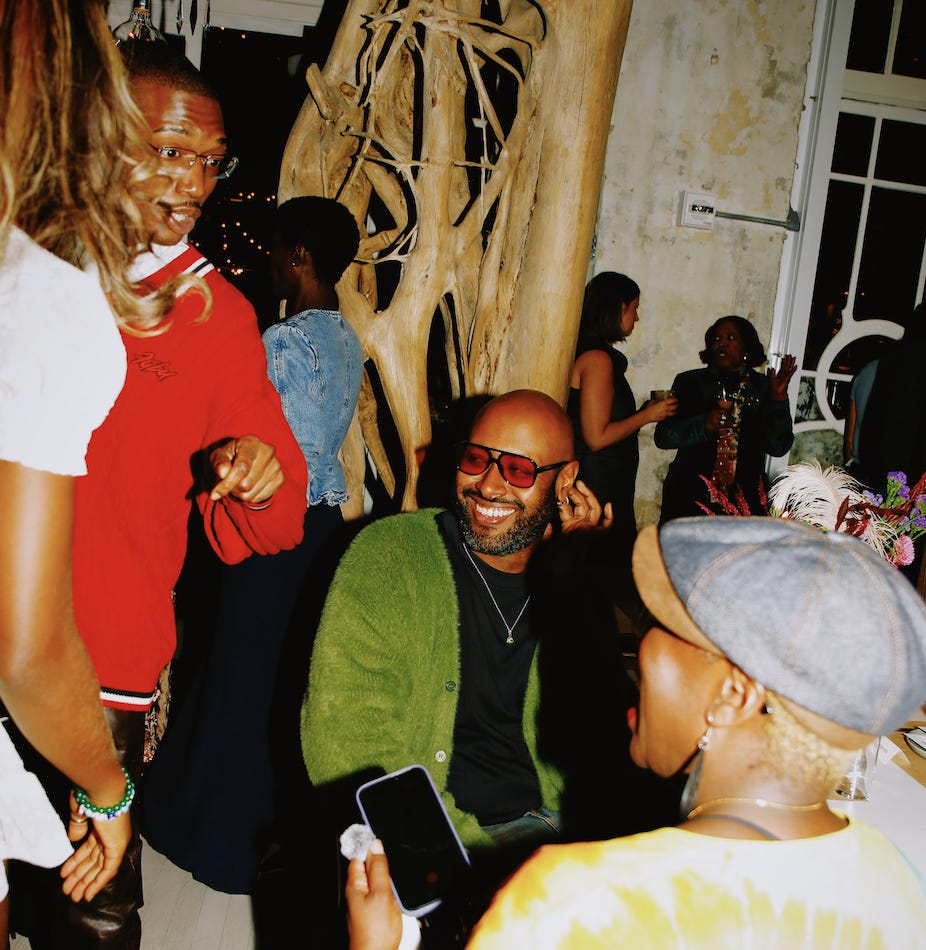
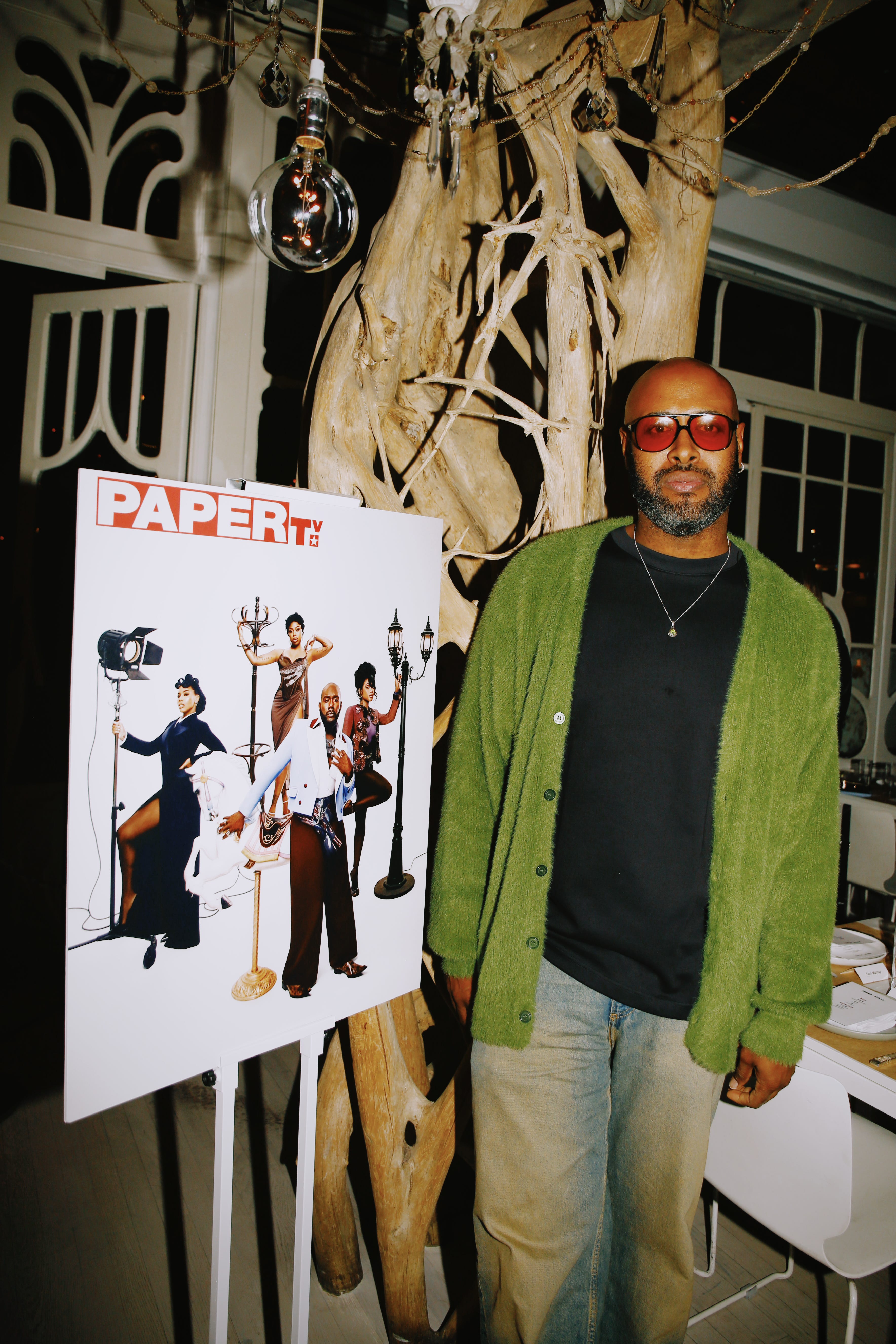
This past week, I celebrated the cast of P-Valley landing the latest cover of Paper with them and creator Katori Hall. Hall, one of my favorite playwrights and artists, also joined me for one of my favorite interviews on Feedback so far. The interview drops in January, ahead of the P-Valley series finale.
Teddy joins me on Feedback next week to discuss my early Roth journey, as well as the midterm election results.