

If you’re obsessed with Vulture’s Cinematrix game like I am, or just love movies, join me for Vulture’s Movies Fantasy League! Last year, I played in their podcasters’ division with a Keep It mini-league. This year, I’ll be participating in their expanded Creators Division, along with other newsletters like Read Max (one of my faves!).
You can join only one mini-league, though, so make sure you join mine, THE THIRDS. You can begin drafting here. Sign up to get a reminder to submit a ballot before scoring starts on September 26.
Charlie Kirk and American myths
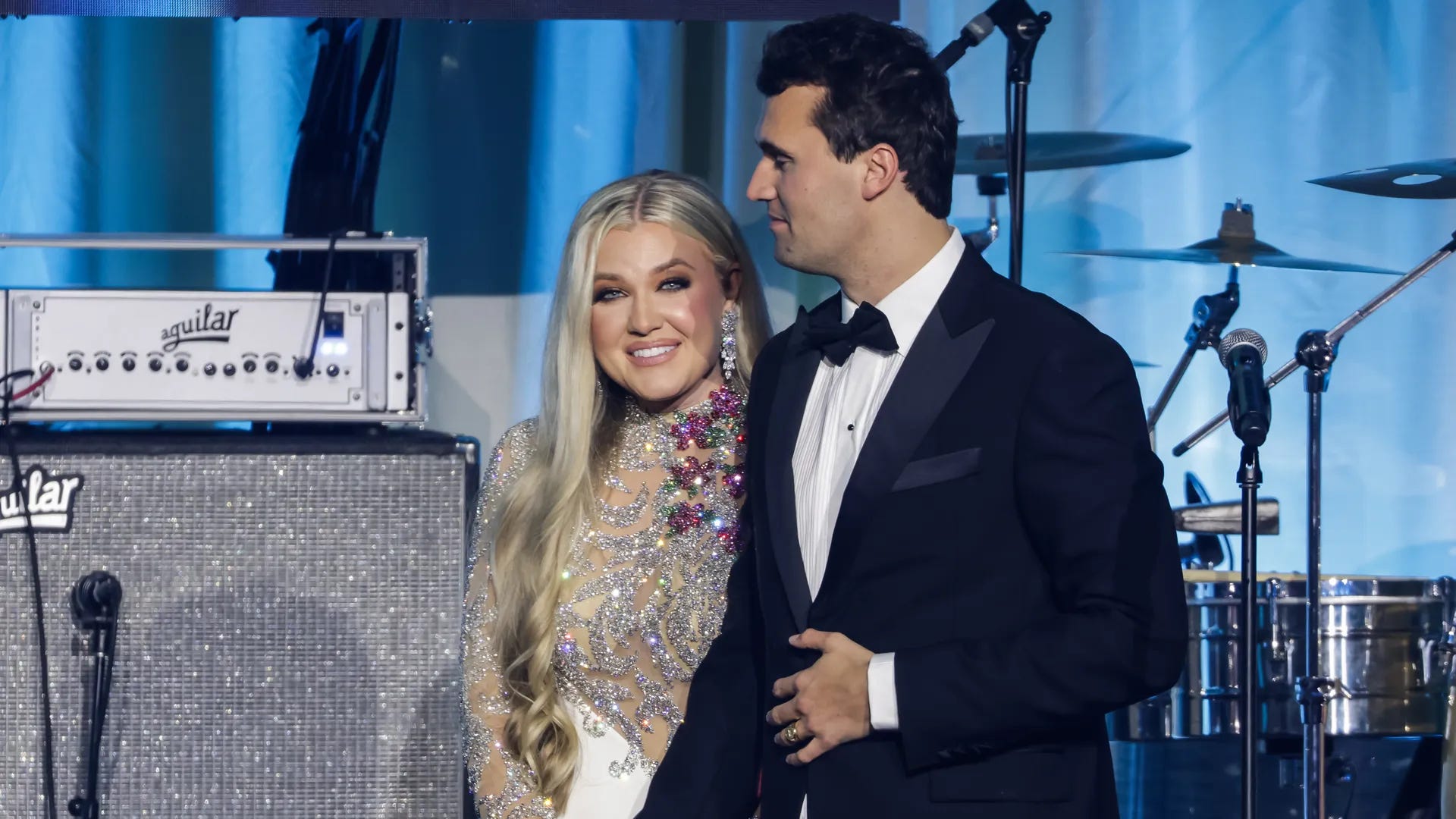
“Who doesn’t want to scam a bitch?” In a March interview with The Fader, Branden Miller, the man behind social media sensation Joanne the Scammer, explained why “scamming” had become so popular in 2016. “Everyone is getting scammed! Look at who the president can be! The fact that Donald Trump could win? The world is such a fucking messy place.” Pejoratives like scammer, fraud, and con artist have been lobbed Trump’s way for decades — but America has always loved a con artist. It's why the town of Ariel, Washington, annually celebrates the day D.B. Cooper hijacked a plane and disappeared with $200,000 in ransom money. It’s how Kellyanne Conway coined the phrase “alternative facts.” And it’s now how the right has swiftly mythologized the openly bigoted Charlie Kirk.
It was expected that Republicans and far-right conservatives would seize on the moment for vainglory. Rep. Nancy Mace made it her mission to find every camera possible to rail against Democrats. Vice President JD Vance took a break from his endless vacations (I think he’s been on more flights than Dua Lipa this year) to host Charlie Kirk’s podcast. But the most surprising, and perhaps the most chillingly effective attempt at redeeming Kirk’s image in the eyes of the American public belonged to his wife, Erika Kirk.
In the wake of his death, Kirk donned a white blazer and spoke from a podium in Kirk’s podcast studio: “No one will ever forget my husband’s name, and I will make sure of it. Our campus tour this fall with continue. There will be even more tours to come. The radio and podcast show that he was so proud of will go on. And in a word filled with chaos, doubt, and uncertainty, my husband’s voice will remain. And it will ring out louder and more clearly than ever. And his wisdom will endure.” During this, she softly touched his chair to remind you that this is where Charlie once sat. The table was also littered with “47” hats, which are “limited edition” merch on Kirk’s website, celebrating Trump’s second Presidential term. I’m not here to police anyone’s grief, but hawking a podcast and a tour and merch in your first public statement on your husband’s death feels shameless and calculated. Later, Erika Kirk shared a photo of her kneeling beside her husband’s casket, kissing him. Today, she was announced as the new CEO of Turning Point USA, her husband’s youth organization that operates more like Magneto’s Brotherhood of Mutants.
It’s been established in the past week that there were two versions of Charlie Kirk online. Thanks to the algorithms that feed us what we want to see, some Americans only saw the clips where he talked about God and healing the nation (and a lot of celebrities, which is not shocking because they all seem to follow Jay Shetty-esque inspirational content on social media). Black people, trans people, and other people with liberal leaning social media algorithms saw the full dimensions of Charlie Kirk. They saw him discuss “black on black crime” and utter phrases like, “prowling Blacks go around for fun to go target white people.” Or that Michelle Obama and Ketanji Brown Jackson did not have "the brain processing power to otherwise be taken really seriously." A fact that Vance lied about in his appearance on Kirk’s podcast.
Erika Kirk gingerly touching her husband’s empty podcast chair, called to mind Jackie Kennedy deciding to wear her blood-stained Chanel suit after the assassination of her husband. Kennedy wanted the nation to witness the carnage through their own eyes. According to historian Steve Gillon, "They actually had another dress laid out for her to put on, and she refused.” I recall a pivotal scene in Pablo Larraín’s 2016 film Jackie, where Natalie Portman’s Kennedy asks her driver if he remembers the name of any assassinated presidents. He can only recall Lincoln because he “freed the slaves.” This prompts Jackie to model her husband's funeral after Lincoln's and to craft a myth that would be their centuries-spanning legacy. During her interview with Life magazine's Theodore H. White, Jackie discusses how she and JFK used to listen to the Broadway cast recording of Camelot every night and how he was particularly moved by the concluding couplet, “Don’t ever let it be forgot, that once there was a spot, for one brief shining moment that was Camelot.” White knew this was untrue, but it was something he wanted to believe.
Charlie Kirk’s vision of America was nothing as beautiful as Camelot. Mordor, perhaps. But to conservatives who want to use his memory to further their own political agendas, he might as well have been JFK, slain on television for a nation to witness. I have no doubt that the Zapruder film capturing JFK’s motorcade would be shared as endlessly on social media as morbidly Kirk’s death was.
Jackie depicts Portman as Kennedy during three spectacularly public moments in her life: her 1962 tour of the White House, her raw grief in the hours after her husband’s assassination, and, finally, her interview a week after JFK's death. Larraín made the choice to portray the first widow as supernaturally self-aware. Portman may lack any type of social media presence. Still, her Jackie would have an Instagram as finely curated as Taylor Swift's — professionally photographed images filtered and Photoshopped to perfection to give the appearance of commonality while keeping the mundane aspects of pointing and clicking with your phone in the wild at arm's length.
Jackie shows a woman with an astute sense of how she's perceived by the world and who carefully cultivates an immaculate image for the American public. Jackie boasts to her Life magazine interviewer of her husband's devotion to the arts, the preserved room where Abraham Lincoln signed the 13th Amendment, and the heirlooms of presidents past that have been bought and bartered for their triumphant return to the White House.
The strain of Jackie's Stepford-esque demeanor only shows its cracks in moments of solitude or during quiet interactions with her brother-in-law Bobby (Peter Sarsgaard). Portman's performance is a bit of a ghost sonata, a methodical dance with inscrutable motivations. Larraín chooses not to focus on Jackie's origins — why she married Kennedy, why she chose her affected voice. But con artists are most mythic when we don't know their motivations. D.B. Cooper is part of the American tapestry because he disappeared, never to be seen again, whereas the man behind Joanne the Scammer just wanted to be famous on the internet, and Trump just wanted to be the most powerful man in America. Knowing their motivations strips away the myth — it makes them human; it keeps them from being larger than life.
Was using JFK’s death to galvanize a country a good thing? Perhaps, yes. For the most part, he was a good man. Kirk, on the other hand, had far too much vitriol in his heart for non-white people. That is a legacy that should not be celebrated or whitewashed. But the problem is, when the media allows mythmaking, it’s a useful tool for any party. It’s how they hid Joe Biden’s cognitive decline. It’s how they allow Trump to lie daily.
But the student who has clearly analyzed Jackie the most carefully in this cycle isn't Larraín or his leading actress — it's Kellyanne Conway, Trump's tenacious, truth-bending campaign manager. Her poise and rigid attention to how she and Trump are perceived are strikingly similar to Portman's Jackie. Jackie's machinations end up most successful when the messiness of life gets in the way, when it spirals out of control due to a sniper's bullet and a piece of your husband’s brain matter in your pink Chanel lap. Her outmaneuvering of government officials to have the grand funeral she's envisioned and her selection of Kennedy's final resting place in Arlington while wandering in a rain-drenched cemetery are stirringly rendered by Larraín. Similarly, disasters like Trump's showing in the first presidential debate and his leaked audio describing sexual assault and grabbing women by their pussy — not to mention his countless Twitter meltdowns — were all inciting incidents to spring Conway into action.
Jackie begins her conversations with White by announcing that she will be editing his piece for him “in case I don't say exactly what I mean.” Conway had no such luxury. Tapped as a replacement for Paul Manafort, Trump's previous campaign manager, in the middle of August 2016, she quickly went to work building her own Camelot for her new candidate. Watching as Portman's Jackie blows cigarette smoke into White's face while simultaneously telling him, “I don't smoke,” called to mind the times Conway said of Trump, “he doesn't hurl personal insults” (a lie) and “nothing has changed as far as the [immigration] policies” (another lie, after Trump claimed he “softened” on deporting millions). In fact, his campaign was found to be 78 percent full of lies and falsehoods in July 2016 by PolitiFact, a nonpartisan fact-checking outlet.
If it weren't for Portman's unsettling, real portrayal of Jackie's real-life grief, her interviews with White would make her seem like Moriarty taunting Sherlock Holmes when she wryly says things like, “People like to believe in fairy tales.” Much has been said about how Trump is gaslighting the American people by feeding them lies and misinformation, but victims of gaslighting have no idea someone is out to get them. Americans became familiar with the term when film stars Ingrid Bergman, Ashley Judd, and Ben Affleck were gaslighting victims in their respective films Gaslight, Double Jeopardy, and Gone Girl. And then had the phrase run into the ground during Trump's first presidency. But, can you gaslight someone who knows they're being lied to and willingly goes along with the lie anyway? That's not gaslighting; that's, as Jackie says, people believing in fairy tales.
Racism fostered Trump's lies about Obama's birth certificate. Misogyny fostered right-wing conspiracies about Hillary Clinton's failing health being kept a secret from the American public. And now, The Washington Post has fired Karen Attiah for reposting Kirk’s own words. Disney pulled Jimmy Kimmel off the air for calling out Kirk’s ideology. And yet again, the media allows Trump to lie and say Kimmel was “fired because he had bad ratings.”
As Wayne Koestenbaum described in Jackie Under My Skin: Interpreting an Icon, “Jackie was likable because she seemed a knockoff aristocrat, palpably ungenuine, and always in danger of being found out.” "Palpably ungenuine is exactly how I’d describe the conservatives falling over themselves to declare Kirk as their King Arthur. But no one is in “danger” of being found out. The media has allowed Trump and his ilk to lie so much with impunity that we already know the truth, but everyone’s afraid to say it unless they lose their jobs. And the people with nothing to lose, whether it's politicians or comedians who’ve claimed to support free speech but remain silent on Kimmel’s silencing, have everything to gain.
The III
I. Cameron Crowe in The New York Times
I watched Singles for the first time this year and revisited Vanilla Sky, so of course I loved this David Marchese interview with Cameron Crowe for The New York Times. It’s one of the best interviews I’ve read all year. More interviews with artists from real journalists, please, and not more nonsense like EE72 launching with Julia Roberts in conversation with… George Clooney. Snore. We all saw the Ticket to Paradise press tour. Did we need that?
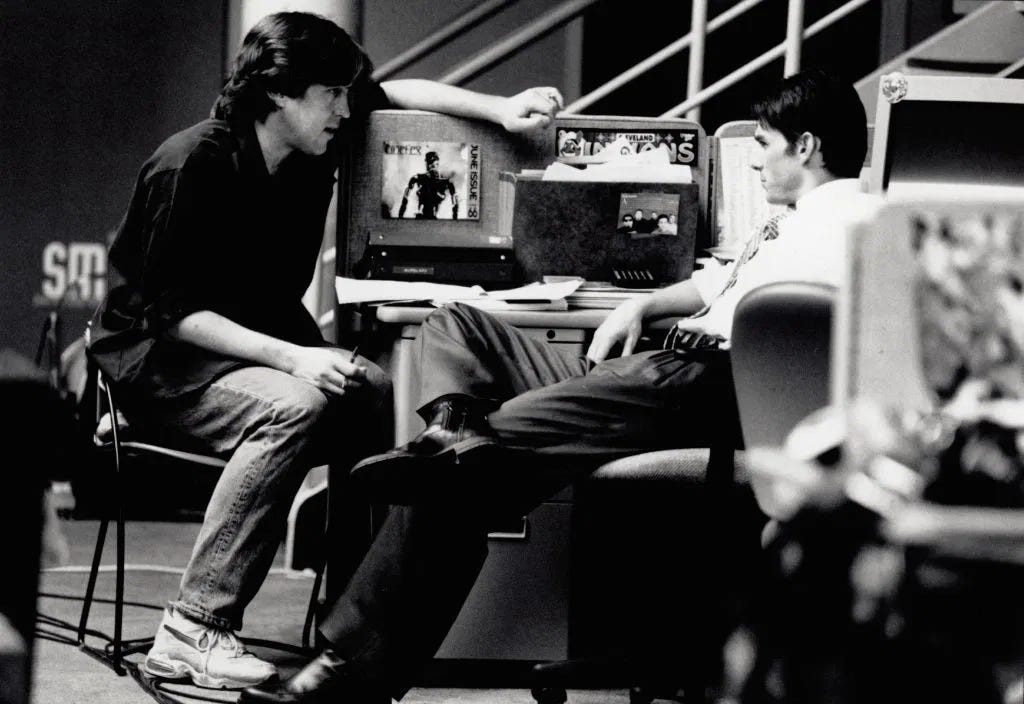
I especially loved this bit from the interview on Tom Cruise.
Marchese: Tom Cruise was, of course, in your films “Jerry Maguire” and “Vanilla Sky.” But I’m curious for your perspective on Tom Cruise’s career over the last 10 years or so. He’s really focused on these spectacular films, the “Mission: Impossible” movies, which are very different from the character-driven performances that he gave for you. Do you think his interests as a storyteller have just diverged from the kind of work that he was making with you?
Crowe: I see that there’s a time coming, and it might have already started, where he’s going to segue into character roles as strongly as he segued into doing action movies of the highest quality. That Paul Newman character phase is just around the corner and will fry people’s minds. I’ll tell you one little thing: I have the same lawyer as Clint Eastwood, and he invited me to a dinner party. He sat me next to Clint Eastwood, and I was so nervous. What do you say to Clint Eastwood? So I’m sitting there and Clint Eastwood leans over and says, “Tom Cruise.” And I go: “Oh, man, Tom Cruise. I love working with Tom Cruise.” And he goes, “In a hundred years, they’re gonna look back — that’s the career, Tom Cruise’s career.”
II. Joni Mitchell’s 1979 Rolling Stone Interview
Crowe began his career as a music writer for Rolling Stone in 1973. In his NYT profile, he mentioned one with Joni Mitchell: “She was my best interview at Rolling Stone. The ’79 interview that we did when she was putting out the “Mingus” album was, by far, the best interview I did there.”
The interview is great. And I would read an entire collected book of Crowe’s interviews with musicians from his Rolling Stones tenure. I’m always in favor of more books on music criticism. I loved this moment where Mitchell describes how she’s perceived by her peers.
Crowe: Would you like to shatter any preconceptions?
Mitchell: I do have this reputation for being a serious person. I’m a very analytical person, a somewhat introspective person; that’s the nature of the work I do. But this is only one side of the coin, you know. I love to dance. I’m a rowdy. I’m a good-timer. Mind you, I haven’t seen too many good parties since I left my hometown. People go to parties here mostly to conduct business.There’s a private club in Hollywood that usually is very empty, but on one crowded evening, I stumbled in there to this all-star cast. Linda Ronstadt was running through the parking lot being pursued by photographers, Jerry Brown was upstairs, Bob Dylan was full of his new Christian enthusiasm – “Hey Jerry, you ever thought of running this state with Christian government?” Lauren Hutton was there, Rod Stewart . . . . There were a lot of people and this little postage stamp of a dance floor, and nobody was dancing on it. These are all people who dance, in one way or another, in their acts.
So the renowned introvert comes in, and I just wanted to dance. I didn’t want to dance alone, so I asked a couple of people to dance with me and nobody would. They were all incredibly shy. So I went to the bathroom, and a girl came in and hollered to me from the sink over the wall, “Is that you? I’ll dance with you.” I said, “Great.” It was just like the Fifties, when none of the guys would dance. And it was at this moment that the girl confided to me, “You know, they all think of you as this very sad person.” That was the first time that it occurred to me that even among my peer group I had developed this reputation. I figured, these guys have been reading my press or something. [Laughs] But as far as shattering preconceptions, forget it. I feel that the art is there for people to bring to it whatever they choose.
III. Nala Sinephro
Someone on Substack posted a few jazz albums they’d been listening to recently. I’ve started listening to jazz in the mornings as a form of meditation (I don’t meditate, but I can disassociate by listening to music). Some of the suggestions included Alice Coltrane and Sun Ra, both of whom I was already familiar with. But I hadn’t heard of Caribbean-Belgian jazz artist Nala Sinephro. As a result, her recent album Endlessness and her 2021 debut, Space 1.8, have been on constant repeat all week.
Ciao,
Ira the Third
I’m so glad you are doing this kind of long form cultural criticism. The comparisons to Jackie, Portman’s performance, Kellyanne Conway and Trump were so sharp and illuminating!
Great piece, Ira. I miss hearing you on the podcast, but we're lucky to still be able to read your thoughts here.